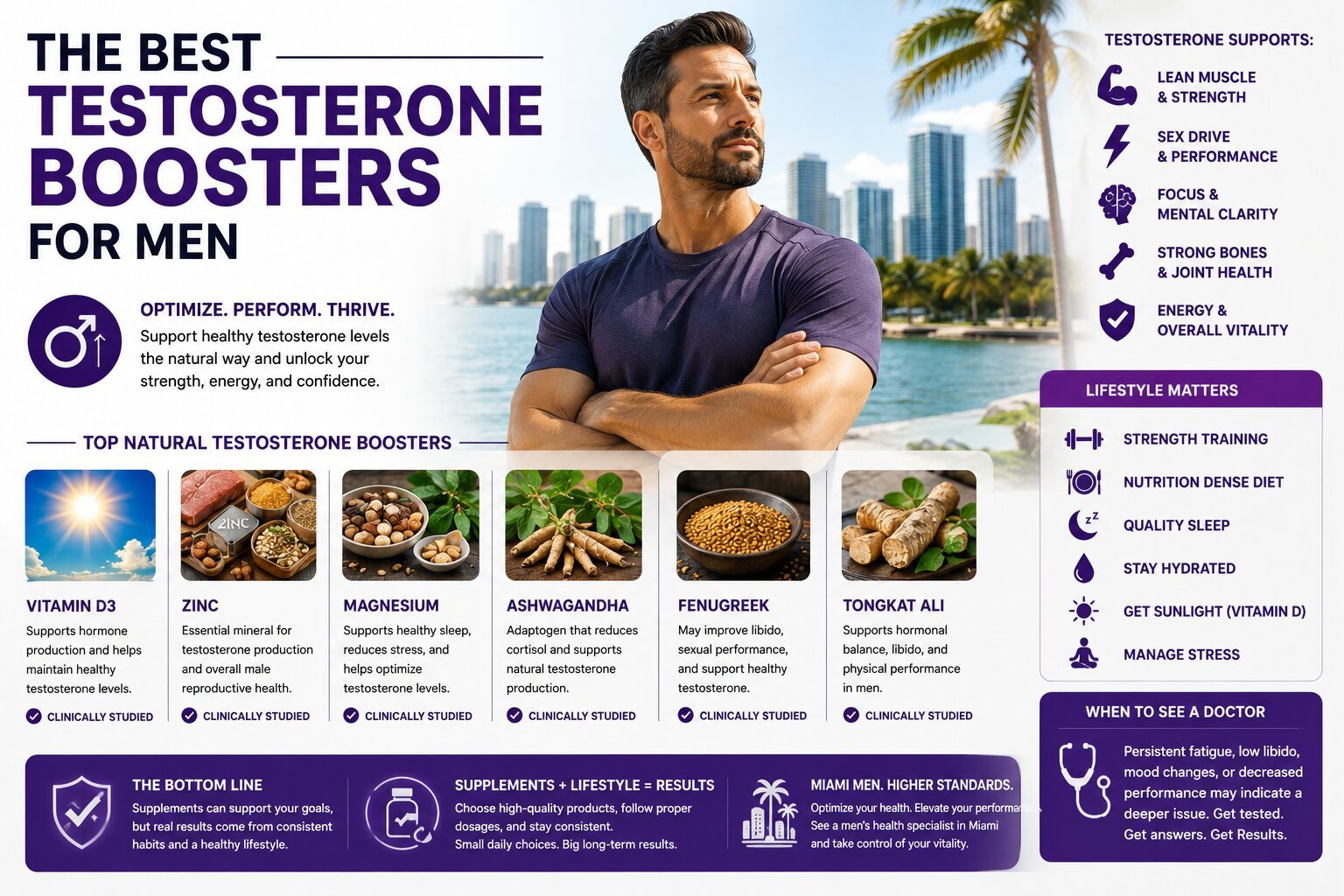
Key Takeaways: Evidence & Expectations
- Nutrient Optimization: Natural supplements (such as Vitamin D3, Zinc, and Magnesium) function primarily by correcting documented deficiencies rather than raising testosterone beyond your genetic ceiling.
- Diagnostic Precision: A single low testosterone result does not establish a diagnosis. Testosterone deficiency is diagnosed through appropriate laboratory testing interpreted together with compatible symptoms and clinical findings.
- Supplements vs. TRT: Dietary supplements yield modest, variable effects, whereas physician-supervised TRT delivers predictable physiological restoration for men with diagnosed hypogonadism.
- Fertility Consideration: Exogenous testosterone suppresses sperm production; men desiring current or future fertility should discuss fertility-sparing alternatives (e.g., hCG or SERMs) before starting TRT.
If you are looking for the best testosterone boosters for men, you have probably noticed that the supplement aisle can feel overwhelming. One bottle promises rapid muscle strength, another claims unstoppable bedroom energy, and a third boasts an exotic blend of herbs that most people have never heard of. The real challenge is separating genuine biological science from clever marketing hype.
Testosterone is a vital androgenic hormone that influences muscle protein synthesis, bone mineral density, sexual drive, red blood cell production, cognitive sharpness, and overall emotional resilience. However, more testosterone is not automatically better. The true clinical goal is achieving and maintaining healthy, physiologically optimized testosterone levels rather than pursuing an arbitrary or unphysiologically elevated number on a laboratory report.
For men living in South Florida, the conversation involves unique lifestyle dynamics. Our year-round sunshine might make vitamin D deficiency seem impossible, yet clinical testing shows that many Florida men who spend their working days indoors have suboptimal levels. Furthermore, high heat and humidity can increase mineral loss through sweat and disrupt sleep. Because your endocrine system responds directly to circadian rhythms, nutritional sufficiency, body composition, and physical activity, an over-the-counter pill can never replace foundational health habits.
This comprehensive medical guide examines the most widely researched natural testosterone boosters—including Vitamin D3, Zinc, Magnesium, Ashwagandha, Fenugreek, and Tongkat Ali. You will discover what clinical studies actually prove, how to dissect supplement labels, when over-the-counter options fall short, and when persistent symptoms warrant a medical consultation with a men's health doctor in Miami.
What Testosterone Does for Men
Testosterone is an essential androgenic steroid hormone synthesized primarily by the Leydig cells in the testes, with minor contributions from the adrenal glands. Regulated by a delicate feedback loop known as the Hypothalamic-Pituitary-Gonadal (HPG) axis, testosterone impacts virtually every organ system in the male body.
In adult men, testosterone plays a central role in maintaining:
- Musculoskeletal Integrity: Stimulates protein synthesis for lean muscle mass and preserves bone mineral density.
- Sexual & Reproductive Health: Drives sexual libido, supports nitric oxide production for erectile firmness, and coordinates spermatogenesis.
- Metabolic Function: Influences insulin sensitivity, fat distribution, and lipid metabolism.
- Cardiovascular Support: Stimulates erythropoiesis (red blood cell production in the bone marrow) for tissue oxygenation.
- Mental & Emotional Health: Modulates neurotransmitters, supporting mood stability, mental clarity, and drive.
That said, every dip in energy or afternoon slump is not necessarily a testosterone crisis. Hormones work in concert with overall physical health. If you are sleeping five hours a night, consuming ultra-processed foods, carrying excess visceral abdominal fat, or dealing with chronic workplace stress, your body will feel exhausted even if your testosterone levels are technically within normal range.
Testosterone levels naturally experience a modest decline of approximately 1% per year after age 30. However, many men maintain healthy, symptom-free levels well into their 60s and 70s. As we discuss in our guide on whether low testosterone always causes erectile dysfunction, treating a lab number in isolation without evaluating symptoms and vascular health often misses the true underlying medical issue.
Common Signs of Low Testosterone
Clinical testosterone deficiency (hypogonadism) presents with a spectrum of symptoms that are often frustratingly nonspecific:
Sexual Symptoms
- Marked reduction in sexual desire (libido)
- Fewer morning or spontaneous erections (why morning erections matter)
- Difficulty maintaining erection rigidity
- Decreased ejaculate volume
Physical & Metabolic Symptoms
- Unexplained chronic fatigue and sluggishness
- Loss of muscle mass and physical strength
- Accumulation of stubborn abdominal fat
- Gynecomastia (development of breast tissue)
Because conditions such as obstructive sleep apnea, clinical depression, thyroid dysfunction, diabetes (diabetes and ED), and cardiovascular disease (ED and heart health) can mimic these exact complaints, you should never treat a checklist as a self-diagnosis. A man struggling with erections may be dealing with microvascular arterial plaque rather than low hormones, requiring therapies such as Shockwave Therapy for ED or regenerative P-Shot PRP injections rather than testosterone supplements.
Can Testosterone Boosters Really Work?
The honest, evidence-based answer is: sometimes, but primarily when correcting an underlying nutritional deficiency or mitigating chronic physiological stress.
Natural testosterone boosters function mainly as deficiency-correction tools or stress-reduction adaptogens. If your body is deficient in a key micronutrient like Zinc or Vitamin D3, replenishing that nutrient removes a biological bottleneck, allowing your testes and endocrine glands to operate at their normal physiological capacity. However, if your body already possesses adequate micronutrient stores, consuming megadoses will not supercharge testosterone production above your natural genetic ceiling.
The Principle of Endocrine Homeostasis
Think of your endocrine system like an engine. If the fuel line is clogged due to a severe nutrient deficiency, clearing the line restores normal horsepower. But adding extra fuel to a clean engine will not turn a standard car into a race car. Once nutritional sufficiency is met, excess supplement doses are simply metabolized and excreted.
Furthermore, dietary supplements in the United States are regulated under the Dietary Supplement Health and Education Act (DSHEA) of 1994. Unlike prescription pharmaceuticals, dietary supplements do not undergo mandatory pre-market clinical trials for efficacy before reaching consumers. This makes independent third-party verification (such as NSF Certified for Sport, USP, or Informed-Choice) essential.
Supplements vs. Testosterone Replacement Therapy (TRT)
It is crucial to understand that over-the-counter dietary supplements and medical Testosterone Replacement Therapy (TRT) are fundamentally different interventions designed for entirely distinct clinical scenarios:
| Feature | Natural Dietary Supplements | Medical TRT (Injections / Pellets) |
|---|---|---|
| Mechanism | Provides raw micronutrients & botanical adaptogens to support the body's natural endogenous production. | Delivers bioidentical exogenous testosterone directly into the bloodstream under medical supervision. |
| Magnitude of Effect | Usually modest and variable. Benefits are more likely when correcting a documented nutritional deficiency or addressing a contributing lifestyle factor. | Clinically meaningful and generally more predictable than supplements in appropriately diagnosed testosterone deficiency. Treatment is individualized and monitored with laboratory testing and symptoms, with the goal of maintaining testosterone within an appropriate physiological range (typically aligning with AUA target ranges of ~450–600 ng/dL). |
| Regulation & Purity | Regulated as food under DSHEA; quality varies widely unless verified by third-party certification. | FDA-approved prescription medications compounded and dispensed under strict pharmaceutical standards. |
| Effect on Fertility | Generally does not suppress natural sperm production or testicular volume. | Exogenous testosterone can suppress LH and FSH signaling and significantly reduce sperm production. Men who are trying to conceive now or wish to preserve fertility should discuss this with a qualified clinician before starting TRT because alternative treatment strategies (such as hCG, SERMs like clomiphene, or aromatase inhibitors) may be appropriate. |
| Clinical Oversight | Self-administered without mandatory medical blood monitoring. | Requires regular clinical blood panels (Total/Free T, PSA, Estradiol, CBC/Hematocrit, Lipid panels). |
Over-the-counter boosters should never be regarded as a "mild substitute for TRT." A single low testosterone result does not establish a diagnosis. Testosterone deficiency is diagnosed through appropriate laboratory testing (specifically, two separate morning total testosterone blood draws) interpreted together with compatible symptoms and clinical findings. If genuine primary or secondary hypogonadism is present, herbal capsules will not resolve the clinical deficiency.
The Better-Studied Testosterone Support Ingredients
When analyzing peer-reviewed clinical literature, a select group of nutrients and botanical extracts rank among the better-studied ingredients for supporting male hormonal health:
1. Vitamin D (The Secosteroid Hormone)
Although classified as a vitamin, Vitamin D behaves as a steroid hormone in the human body. Receptors for Vitamin D (VDR) are expressed throughout the male reproductive tract, including within the Leydig cells of the testes.
What the Science Says: Large observational studies link Vitamin D deficiency (<20 ng/mL) with lower total and free testosterone levels. Clinical trials in men with baseline deficiency demonstrate that restoring serum 25-hydroxyvitamin D improves circulating testosterone compared to placebo. However, taking high doses when levels are already normal does not continuously increase testosterone.
Clinical Takeaway: Men with suspected vitamin D deficiency can discuss measurement of serum 25-hydroxyvitamin D with their healthcare provider. Supplementation should be individualized according to baseline levels, diet, sun exposure, medical history, and other sources of vitamin D. In clinical trials where deficiency was corrected, daily doses typically ranged from 2,000 to 5,000 IU of Vitamin D3, often combined with Vitamin K2 to support proper calcium metabolism.
2. Zinc (Essential Trace Mineral)
Zinc is an indispensable cofactor for more than 300 enzymatic reactions in the human body, playing a central role in cellular repair, immune defense, and testosterone synthesis.
What the Science Says: Landmark research demonstrated that severe dietary zinc restriction in healthy men led to a substantial reduction in circulating testosterone concentrations. Conversely, administering zinc supplementation to marginally zinc-deficient men resulted in a statistically significant increase in serum testosterone.
Clinical Takeaway: Zinc is lost through perspiration, making active men in warm climates more susceptible to marginal depletion. A sensible daily supplemental dose is 15 to 30 mg of bioavailable zinc (such as Zinc Picolinate or Zinc Glycinate). Chronic intake exceeding 40 mg/day should be avoided, as excessive zinc competitively inhibits copper absorption, potentially leading to copper deficiency and anemia.
3. Magnesium (Neuromuscular & Bioavailability Support)
Magnesium is heavily involved in energy metabolism, muscle recovery, blood glucose regulation, and sleep quality. In the bloodstream, a large fraction of testosterone is bound to Sex Hormone-Binding Globulin (SHBG).
What the Science Says: Research indicates that magnesium unbinds a portion of testosterone from SHBG, supporting higher biological availability. Clinical trials in athletes supplementing with magnesium demonstrated increases in free and total testosterone following intense physical training compared to non-supplemented controls.
Clinical Takeaway: Men engaging in regular resistance training or high-heat outdoor exercise frequently experience increased magnesium demands. Daily supplementation with 200 to 400 mg of Magnesium Glycinate or Malate supports cellular recovery, muscle relaxation, and restorative sleep.
4. Ashwagandha (Withania somnifera)
Ashwagandha is a revered botanical adaptogen in Ayurvedic medicine studied for its ability to modulate the body's response to psychological and physical stress.
What the Science Says: Chronic psychological stress, inadequate recovery, and sleep disruption can influence the hypothalamic-pituitary-gonadal axis and may adversely affect reproductive and hormonal function. Some randomized trials of standardized ashwagandha extracts (such as KSM-66® or Sensoril®) have reported reductions in perceived stress or cortisol and modest increases in testosterone in certain male populations. However, results should not be interpreted as evidence that ashwagandha reliably treats clinical testosterone deficiency.
Clinical Takeaway: Ashwagandha is best viewed as a stress-mitigating adaptogen. Standardized root extract doses of 300 to 600 mg daily are generally well-tolerated in clinical studies.
Other Botanicals in Men's Health Formulations
Beyond foundational micronutrients, two botanical compounds are widely included in commercial men's formulas:
Fenugreek (Trigonella foenum-graecum)
Fenugreek seeds contain furostanolic saponins—plant compounds investigated for their effects on androgen metabolism and libido.
In clinical trials evaluating standardized extracts (such as Testofen®), men supplementing with 500 to 600 mg daily reported improvements in sexual arousal, energy levels, and satisfaction. While some trials observed minor increases in free testosterone, much of fenugreek's clinical effect appears related to subjective improvements in libido rather than massive androgenic elevation.
Caution: Fenugreek can lower blood glucose and may interact with diabetic medications or antiplatelet agents.
Tongkat Ali (Eurycoma longifolia / Longjack)
Indigenous to Southeast Asia, Tongkat Ali contains bioactive quassinoids (such as eurycomanone) that have been studied for their effects on stress and hormone balance.
A study published in the Journal of the International Society of Sports Nutrition evaluated moderately stressed individuals receiving 200 mg daily of standardized Tongkat Ali extract for four weeks, observing reductions in salivary cortisol and increases in salivary testosterone within that study cohort. However, individual consumer results vary, and it should not be considered a stand-in for medical therapy.
Caution: The market for Tongkat Ali includes low-potency root powders. Consumers should look for standardized water-soluble extracts from manufacturers providing third-party Certificates of Analysis (COA).
How to Evaluate a Men's Health Supplement
Selecting a supplement requires looking past aggressive advertising. Use this clinical checklist before purchasing any formula:
What to Look For
- Full Label Transparency: Exact milligram quantities listed for every individual ingredient.
- Standardized Botanical Extracts: Verified active percentages (e.g., KSM-66® Ashwagandha).
- Third-Party Certification: Verification seals from NSF, USP, BSCG, or Informed-Choice.
- Bioavailable Chelates: Zinc Picolinate/Glycinate and Magnesium Glycinate over cheap oxide forms.
Red Flags to Avoid
- "Proprietary Blends": Formulations that hide individual ingredient dosages under a collective weight.
- Unrealistic Marketing: Promises of "300% testosterone surges" or "instant steroid-like muscle gains."
- Excessive Stimulants: Heavy caffeine content designed to mimic energetic vitality artificially.
- Unvetted Online Vendors: Products lacking third-party quality testing or batch verification.
Before Taking a Testosterone Booster, Consider Testing Your Testosterone
Fatigue, decreased libido, erectile problems, loss of muscle mass, increased abdominal fat, and reduced motivation are nonspecific symptoms. Rather than cycling through over-the-counter supplements and guessing what your body needs, appropriate diagnostic laboratory testing can help determine whether testosterone deficiency—or another underlying health issue—is actually present.
In accordance with American Urological Association guidelines, a diagnosis of testosterone deficiency requires two separate early morning blood draws (when testosterone levels peak) interpreted together with clinical symptoms. If your blood levels are normal, spending money on booster supplements will not resolve your fatigue—and if your levels are clinically low, over-the-counter pills cannot replace comprehensive medical care.
Schedule a Comprehensive Testosterone Evaluation in Miami
Get an accurate, physician-led diagnostic evaluation with Dr. Nina Gupta, MD to pinpoint your exact hormone levels and review personalized, evidence-based treatment options.
Book Your Hormone EvaluationTestosterone Optimization and Florida Men
Living in South Florida offers wonderful outdoor lifestyle advantages across Miami, Aventura, Fort Lauderdale, and the Palm Beaches. However, our subtropical climate introduces specific physiological factors that impact hormonal balance:
Heat, Perspiration, and Vitamin D Dynamics
The Sunshine Paradox: Despite abundant sunlight, professionals who work indoors, commute in air-conditioned vehicles, and use sunblock frequently show suboptimal Vitamin D levels on clinical testing. Periodic 25-OH Vitamin D blood testing combined with individualized supplementation is safer and more reliable than excessive sun exposure.
Sweat and Trace Mineral Loss: High ambient humidity dramatically increases perspiration during outdoor workouts. Critical minerals—including Zinc and Magnesium—are lost through heavy sweat. If unreplenished, mineral depletion accelerates fatigue and elevates resting stress markers.
Sleep Environment: Testosterone synthesis occurs primarily during deep REM and slow-wave sleep. Maintaining a cool bedroom environment (65–68°F) and screening for sleep apnea are essential for preserving nocturnal testosterone production.
Safety, Side Effects, and Drug Interactions
Botanical compounds and concentrated minerals exert real biochemical effects and can cause adverse reactions or medication interactions:
- Mineral Overlap: Combining multiple supplements can lead to excessive zinc intake (>40 mg/day), resulting in nausea and copper deficiency.
- Gastrointestinal Tolerance: High doses of fenugreek or poorly absorbed mineral forms (such as magnesium oxide) can cause cramping or diarrhea.
- Thyroid & Autoimmune Considerations: Ashwagandha may influence thyroid hormone concentrations and should be used with caution in individuals with thyroid disease.
- Medication Interactions: Botanicals like Fenugreek and Tongkat Ali can interact with blood sugar-lowering medications and anticoagulants.
- Contamination Risks: The FDA regularly flags unapproved male enhancement supplements containing undeclared prescription drug analogs. Always choose reputable, third-party certified products.
Evidence-Based Lifestyle Habits for Testosterone
Before or alongside any supplement, establishing foundational lifestyle habits delivers the most sustainable endocrine benefits:
1. Progressive Resistance Training
Engage in compound multi-joint resistance training 3 to 4 times weekly to stimulate androgen receptor activity and maintain lean body mass.
2. Restorative Sleep (7–9 Hours)
Prioritize uninterrupted sleep. Sleep restriction to 5 hours nightly has been shown to reduce daytime testosterone levels in young men by 10% to 15%.
3. Whole-Food Nutrition & Healthy Fats
Consume adequate dietary fats (olive oil, avocados, wild fish, eggs) which supply cholesterol substrates for steroidogenesis, balanced with lean protein and fiber.
4. Manage Visceral Adiposity & Alcohol
Excess abdominal fat increases aromatase enzyme activity, converting testosterone into estrogen. Reducing visceral fat and moderating alcohol naturally supports bioavailable testosterone.
Conclusion
The best testosterone booster for men is not a flashy pill promising overnight transformations. For men with documented nutritional shortfalls, targeted supplementation with Vitamin D3, Zinc, and Magnesium provides genuine biological support. Furthermore, adaptogenic herbs like Ashwagandha and Tongkat Ali offer modest benefits for stress modulation and subjective vitality.
However, supplements cannot overcome severe sleep deprivation, chronic stress, or organic hypogonadism. If you are experiencing persistent fatigue, low libido, or erectile difficulties, obtaining a professional diagnostic evaluation is the most effective step. With accurate blood testing and personalized medical care from an experienced testosterone physician in Miami, you can optimize your health with safety and confidence.
Frequently Asked Questions About Testosterone Boosters for Men
References & Authoritative Medical Guidelines
- American Urological Association (AUA): Diagnosis and Management of Testosterone Deficiency (Guideline 2018, Confirmed 2024).
- American Urological Association (AUA) / American Society for Reproductive Medicine (ASRM): Diagnosis and Treatment of Infertility in Men (AUA/ASRM Guideline).
- National Institutes of Health (NIH) Office of Dietary Supplements: Fact Sheets for Health Professionals — Zinc, Vitamin D, and Magnesium.
- Prasad AS, et al.: Zinc status and serum testosterone levels of healthy adults. Nutrition, 1996; 12(5):344-348.
- Pilz S, et al.: Effect of vitamin D supplementation on testosterone levels in men. Hormone and Metabolic Research, 2011; 43(3):223-225.
- Cinar V, et al.: Effects of magnesium supplementation on testosterone levels of athletes and sedentary subjects at rest and after exhaustion. Biological Trace Element Research, 2011; 140(1):18-23.
- Lopresti AL, et al.: A randomized, double-blind, placebo-controlled, crossover study examining the hormonal and vitality effects of Ashwagandha (Withania somnifera) in aging, overweight males. American Journal of Men's Health, 2019; 13(2).
- Talbott SM, et al.: Effect of Tongkat Ali on stress hormones and psychological mood state in moderately stressed subjects. Journal of the International Society of Sports Nutrition, 2013; 10(1):28.