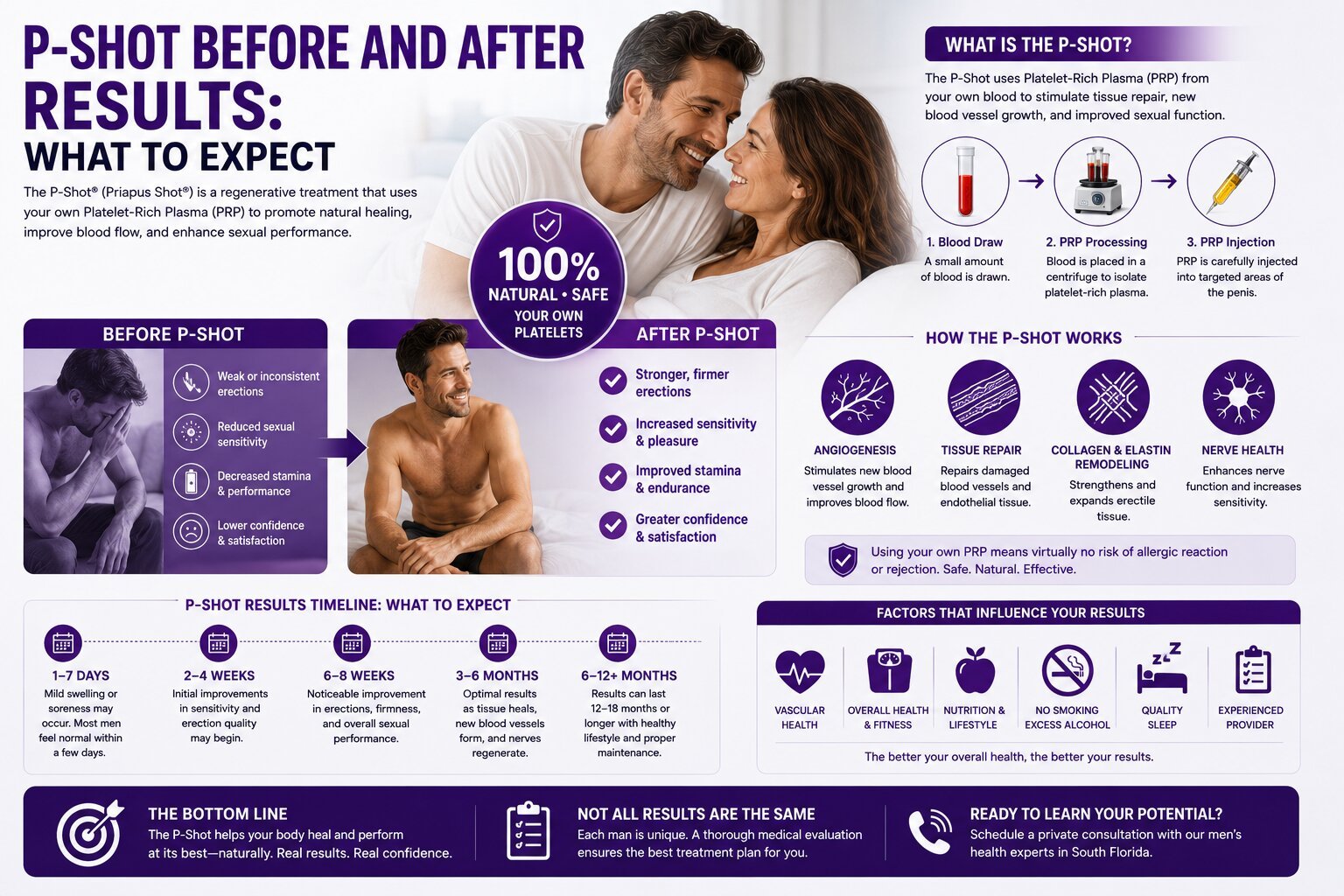
Key Takeaways: Setting Realistic Expectations
- Biological Regeneration vs. Overnight Magic: The P-Shot relies on autologous Platelet-Rich Plasma (PRP) to stimulate cellular repair and neovascularization; results develop gradually over 4 to 12 weeks rather than overnight.
- Functional vs. Cosmetic Focus: The primary clinical objective of penile PRP is improving erectile firmness, vascular holding capacity, sensation, and recovery time—not dramatic surgical enlargement.
- Individual Variability: Patient outcomes depend heavily on baseline endothelial health, age, cardiovascular status, diabetes control, and hormone balance.
- Comprehensive Medical Evaluation: An accurate diagnostic evaluation with an experienced men's health doctor in Miami is essential to identify the underlying cause of sexual dysfunction.
If you are searching for P-Shot before and after results, you are likely looking for something far more valuable than exaggerated promotional photos or vague online promises. You want to understand what the treatment actually entails, when you can realistically expect changes, how long those improvements might last, and whether the outcomes advertised across the internet reflect genuine medical science.
That critical approach is essential. The Priapus Shot® (P-Shot®) is an advanced regenerative therapy that utilizes concentrated Platelet-Rich Plasma (PRP) derived from your own blood to promote tissue repair, stimulate microvascular signaling, and support sexual performance. However, clinical response varies between individuals. While many men experience significant improvements in erection rigidity, sensitivity, and sexual satisfaction, outcomes depend on underlying vascular integrity, metabolic health, and proper clinical protocol execution.
In this evidence-based guide, we examine the true physiological reality of P-Shot before and after results, detail the month-by-month recovery timeline, discuss the factors influencing patient success, and explain how a comprehensive medical evaluation in South Florida ensures the highest likelihood of clinical success.
What Is the P-Shot and How Does It Work?
The P-Shot utilizes autologous Platelet-Rich Plasma (PRP)—a specialized concentration of blood platelets containing high levels of active growth factors, cytokines, and cellular signaling molecules. During the in-office procedure, a small sample of your blood is collected and processed using a specialized high-yield medical centrifuge. This separates the platelet-dense plasma from red and white blood cells.
When this purified PRP is carefully injected into targeted zones of the penis (specifically the corpus cavernosum erectile chambers and the glans), the concentrated growth factors initiate a cascade of regenerative biological processes:
- Angiogenesis & Neovascularization: Vascular Endothelial Growth Factor (VEGF) and Platelet-Derived Growth Factor (PDGF) stimulate the formation of new micro-capillaries, improving arterial inflow.
- Endothelial Tissue Repair: Supports the rejuvenation of damaged endothelial linings within the vascular beds, promoting natural nitric oxide release for smooth muscle relaxation.
- Collagen & Elastin Remodeling: Fibroblast Growth Factor (FGF) supports structural tissue integrity and expansion of the erectile chambers.
- Neuro-Sensory Modulation: Enhances local nerve health and cellular sensitivity across the penile shaft and glans.
Because PRP is derived entirely from your own biological tissue, the procedure carries an exceptional safety profile with virtually zero risk of allergic rejection. As we explore in our detailed overview on how the P-Shot works, the goal is not to artificially force an erection with a temporary pharmaceutical pill, but to restore the underlying biological health of the erectile tissue itself.
What Happens During a P-Shot Treatment in Miami?
A common misconception is that the P-Shot is a painful or complex surgical procedure. In reality, the entire treatment is performed comfortably in an outpatient clinical setting in approximately 45 to 60 minutes:
Comprehensive Evaluation
Dr. Nina Gupta performs a detailed medical intake, evaluating cardiovascular health, hormonal balance, medication history, and specific sexual health goals.
Blood Draw & PRP Isolation
A quick, routine blood draw is performed. The blood is processed in an Eppendorf centrifuge system to concentrate platelets for autologous PRP preparation.
Numbing & Micro-Injection
A high-potency topical anesthetic cream ensures complete numbness. The PRP is precisely delivered via micro-needle into specific anatomical zones with zero downtime.
Most patients experience only mild pressure during the injection. You can drive yourself home immediately afterward and resume normal daily activities, with many men able to resume sexual intimacy within 24 to 48 hours following medical guidance.
P-Shot Before and After Results: What Changes Can You Expect?
When reviewing P-Shot before and after pictures online, men often wonder whether physical size changes or functional improvements are the primary outcome. Setting clear clinical expectations is critical:
| Clinical Metric | Before P-Shot Therapy | Realistic After Results |
|---|---|---|
| Erection Firmness & Rigidity | Inconsistent firmness, soft glans, or difficulty maintaining erection during intercourse. | Improved firmness and stability in responsive patients due to enhanced microvascular blood flow and cavernous engorgement. |
| Spontaneous Erections | Infrequent or absent nocturnal/morning erections (why morning erections matter). | Some men observe improved frequency or quality of spontaneous morning erections; however, individual responses vary and restoration is not guaranteed. |
| Penile Girth & Fullness | Reduced tissue fullness or partial volume loss associated with aging and diminished perfusion. | Enhanced sensation of erect fullness and engorgement; however, reliable permanent enlargement in length or girth is not clinically established by scientific trials. |
| Sensitivity & Pleasure | Diminished penile sensation, requiring aggressive stimulation for climax. | Heightened tactile responsiveness and improved sensitivity reported by many patients following treatment. |
| Refractory Period | Extended recovery time required before achieving a second erection. | Gradual improvement in recovery time between sexual encounters may be observed in receptive patients. |
The P-Shot Results Timeline: What Does Clinical Evidence Show?
Because autologous PRP delivers platelet-derived signaling molecules rather than an immediate pharmaceutical response, biological changes develop gradually. However, patient response varies widely, and some men experience modest or no measurable improvement:
Immediate Post-Procedure & Early Healing
Mild soreness, pinpoint bruising, or temporary injection-site swelling may occur. Initial fluid volume is gradually absorbed by surrounding tissues over 48 to 72 hours as concentrated growth factors initiate cellular communication.
Early Cellular Adaptation & Sensation
Some patients begin noticing subtle improvements in shaft sensitivity or spontaneous morning firmness as early microvascular signaling begins. Other patients may notice minimal change during this preliminary phase.
Evaluation Window & Clinical Follow-Up
Clinical trials evaluating penile PRP measure changes during this window using validated indices (such as the IIEF-5). Men who respond typically achieve their optimal firmness and responsiveness by 8 to 12 weeks. A structured follow-up consultation evaluates individual progress.
Long-Term Maintenance & Individual Longevity
The longevity of therapeutic benefits varies depending on underlying vascular health, metabolic control, and lifestyle. While many responding patients maintain benefits for 12 months or longer, periodic reassessment helps determine if additional or complementary care is warranted.
P-Shot Before and After for Erectile Function vs. Sensation
Two of the most significant clinical improvements evaluated during follow-up consultations are erectile firmness and tactile sensitivity:
1. Restoration of Vascular Erectile Rigidity
Erectile dysfunction is predominantly a vascular condition influenced by impaired arterial inflow, microvascular resistance, or cavernous smooth muscle alteration. In clinical research, autologous PRP is evaluated for stimulating microvascular endothelial signaling and tissue perfusion. Men who previously struggled with soft erections or losing rigidity mid-intercourse often experience an improvement in their International Index of Erectile Function (IIEF-5) clinical scores. For patients with vasculogenic concerns, combining the P-Shot with Shockwave Therapy for ED provides complementary acoustic wave pulses to support microvascular circulation.
2. Heightened Sensory Nerve Responsiveness
Men with diabetic neuropathy, previous pelvic surgery, or age-related sensory decline frequently experience reduced penile sensation. The growth factors in PRP support peripheral nerve signaling, helping restore tactile sensitivity to the glans and shaft. This makes sexual intimacy significantly more pleasurable and facilitates more dependable, robust orgasms.
Key Factors That Influence Your P-Shot Results
Why does one man report dramatic before-and-after improvements while another notices more subtle changes? Clinical outcomes depend on several critical physiological variables:
The "Seed and Soil" Principle of Regenerative Medicine
PRP acts like fertile seeds and fertilizer. However, the eventual harvest depends on the quality of the "soil"—your overall biological health. A man with well-managed blood pressure, balanced hormones, and active circulation will experience faster and more robust vascular regeneration than a patient with severe uncontrolled diabetes or heavy tobacco use.
- Endothelial & Cardiovascular Health: Healthy blood vessels respond more rapidly to angiogenic growth factors. Controlling cholesterol, managing blood sugar (diabetes and ED), and staying physically active maximizes results.
- Hormonal Sufficiency (Testosterone Levels): Testosterone directly regulates nitric oxide synthase in penile tissue. If total or free testosterone is clinically deficient, combining PRP with Testosterone Replacement Therapy (TRT) produces far superior outcomes.
- PRP Preparation Quality & Concentration: Dr. Nina Gupta prepares autologous platelet-rich plasma from the patient's own blood using a precision Eppendorf centrifuge system to ensure optimal platelet separation under strict clinical protocols.
- Physician Expertise & Injection Technique: Dr. Nina Gupta brings over 37 years of clinical medical experience, ensuring precise depth, accurate volume distribution, and adherence to official Priapus Shot® certified training protocols.
Are P-Shot Results Permanent?
Because the P-Shot stimulates biological tissue signaling and microvascular support, the effects are longer-lasting than situational oral medications. However, no medical therapy permanently halts the natural vascular aging process.
Clinical benefits typically persist for 12 to 18 months in responsive individuals. Over time, natural vascular aging, stress, and lifestyle factors can gradually affect circulation again. For this reason, many patients choose periodic reassessment or an annual maintenance session.
How to Maximize Your P-Shot Results in Miami
To achieve the best possible before-and-after outcome from your PRP therapy, Dr. Nina Gupta recommends following these evidence-based clinical practices:
1. Daily Cardiovascular Exercise
Engage in 30 minutes of moderate aerobic exercise (brisk walking, cycling, swimming) to stimulate systemic endothelial nitric oxide release and accelerate penile revascularization.
2. Post-Procedure Vacuum Therapy (VED)
Utilize a medical-grade vacuum erection device (VED) for 10 minutes daily starting a few days post-injection. This draws fresh, oxygen-rich blood into the treated tissue, supporting vascular conditioning.
3. Complementary Acoustic Wave Therapy
Pairing autologous PRP with low-intensity Acoustic Wave Therapy delivers mechanical pulses investigated for supporting microvascular circulation and cellular responsiveness.
4. Restorative Sleep & Hydration
Hydrate well before and after treatment to optimize platelet concentration. Prioritize 7 to 9 hours of sleep nightly, when human growth hormone and tissue repair mechanisms are most active.