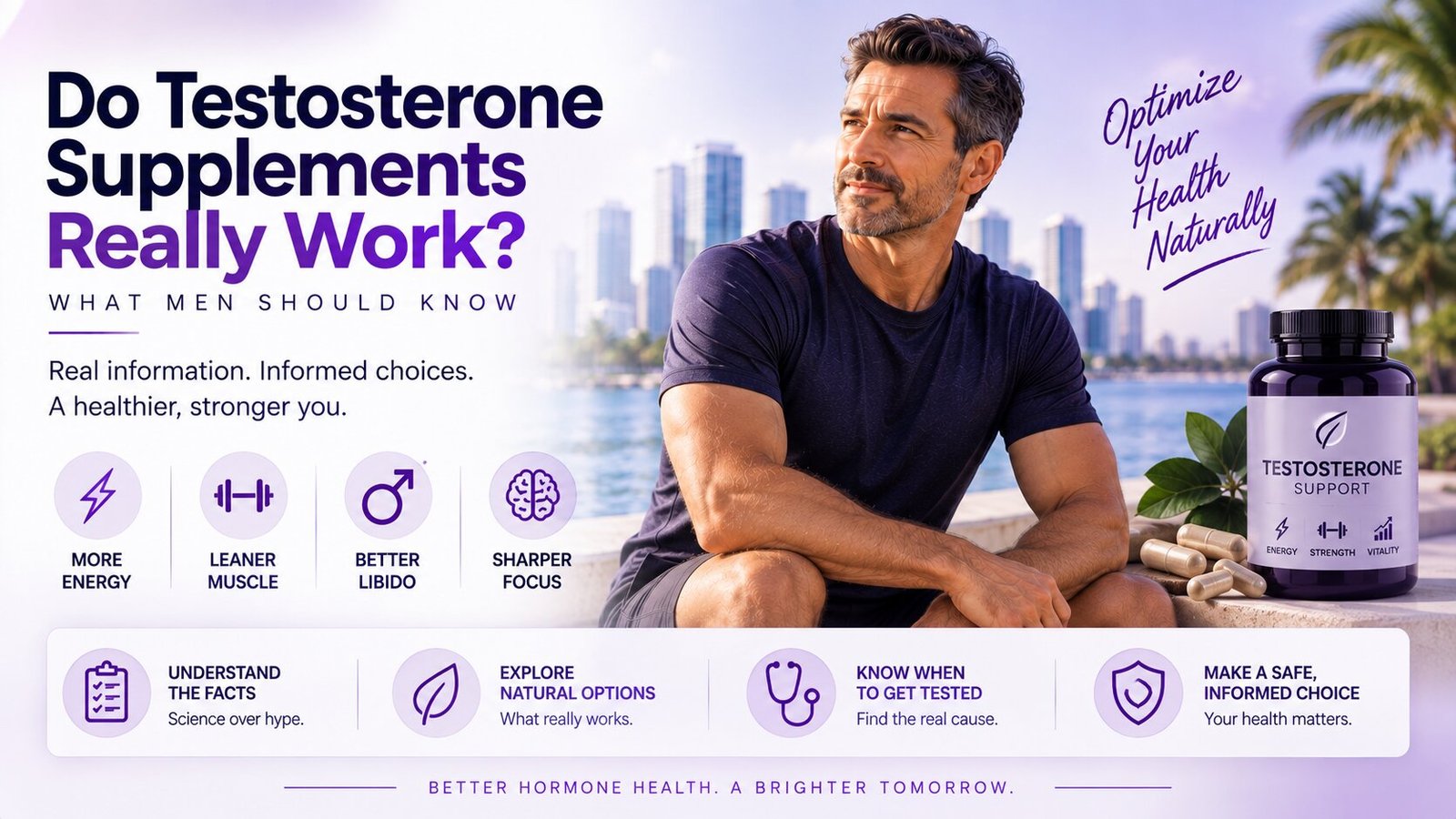
Low energy can creep up gradually. Maybe workouts no longer produce the strength or muscle gains they once did. Perhaps your interest in sex has diminished, you are noticing stubborn weight accumulation around your waistline, or you simply do not feel as mentally sharp, driven, and energized as you used to.
When several of these symptoms appear together, it is completely natural to wonder whether low testosterone is responsible. Search online for answers, and you will immediately encounter an enormous marketplace of capsules, powders, gummies, botanical extracts, and "natural testosterone boosters" promising to restore your hormone levels to their youthful peak.
However, this is where things get complicated: feeling different does not automatically mean your testosterone is clinically low, and buying an over-the-counter product labeled "testosterone supplement" does not mean you are actually taking testosterone. These are two fundamentally different issues that are frequently blurred together in aggressive consumer advertising.
Clinical Reality Check
While certain nutritional ingredients can be clinically beneficial when a patient has a documented deficiency, most popular herbal boosters have limited, inconsistent, or inconclusive scientific evidence for raising serum testosterone. In contrast, prescription Testosterone Replacement Therapy (TRT) is an FDA-approved medical treatment intended for appropriately diagnosed hypogonadism that requires clinical blood monitoring.
So, do testosterone supplements really work? For the vast majority of over-the-counter formulas, scientific evidence does not support the dramatic claims made on their labels. That does not mean every nutrient is ineffective, nor does it mean your symptoms should be dismissed. It means the smarter starting point is uncovering the true root cause through objective laboratory testing and matching treatment to your unique biology.
Testosterone is only one component of a broader physiological ecosystem. Sleep architecture, body composition, metabolic health, medications, chronic stress, alcohol intake, thyroid function, and cardiovascular health all influence how a man feels and performs. A retail supplement bottle promising "Maximum T" cannot diagnose which of those factors is actually driving your fatigue or performance concerns.
What Are Testosterone Supplements?
The term "testosterone supplement" is surprisingly broad. In commercial marketing, it almost always refers to over-the-counter (OTC) dietary supplements promoted as "testosterone boosters." These formulas generally combine micronutrients and herbs such as zinc, magnesium, vitamin D, ashwagandha, fenugreek, Tribulus terrestris, D-aspartic acid, or proprietary botanical blends.
Despite their names, these dietary products contain zero actual testosterone. Their stated premise is to supply raw micronutrients or botanical compounds that might support the body's endogenous hormone production pathways or promote general wellness.
While that sounds straightforward, marketing claims often outpace medical reality. A bottle might claim to "support free testosterone," "optimize male hormones," or "promote natural anabolic vitality." However, structural marketing language does not mean clinical trials have shown that the finished commercial product produces meaningful, lasting increases in serum testosterone or resolves clinical hypogonadism in men.
Over-the-Counter Testosterone Boosters vs. TRT
To understand why these categories are so different, consider an analogy: taking a dietary supplement is like attempting to encourage a factory to increase production through minor resource adjustments, whereas Testosterone Replacement Therapy (TRT) directly delivers the finished product that the factory is no longer producing adequately.
| Feature / Category | OTC Testosterone Boosters | Prescription TRT |
|---|---|---|
| Active Hormone Content | None (Vitamins, minerals, herbs) | Pure Bioidentical Testosterone |
| Regulatory Status | Dietary Supplement (No FDA pre-market efficacy proof) | FDA-Approved Prescription Medication |
| Diagnostic Requirement | None (Purchased over the counter) | Comprehensive morning blood panels & clinical diagnosis |
| Serum Hormone Impact | Unreliable / Minimal (unless correcting specific deficiency) | Predictable, therapeutic restoration to optimal physiological range |
| Ongoing Medical Monitoring | None provided | Regular monitoring of Total/Free T, Estradiol, PSA, CBC/Hematocrit |
Why the Difference Matters
This distinction is crucial when symptoms are actively impairing your daily performance and vitality. If persistent exhaustion, loss of libido, erectile difficulties, or muscle loss are diminishing your quality of life, masking the issue with an unverified retail booster may delay essential medical evaluation. Your symptoms could stem from hypogonadism, or they could indicate cardiovascular disease, diabetes, thyroid dysfunction, or sleep apnea.
Furthermore, "natural" is not synonymous with "safe." Dietary supplements can have pharmacological interactions, stress liver metabolism, contain excessive mineral doses, or suffer from poor manufacturing quality. Regulatory agencies have repeatedly found products marketed for male enhancement and bodybuilding to contain undeclared prescription drugs, phosphodiesterase inhibitors, or synthetic steroid analogs.
Do Over-the-Counter Testosterone Boosters Actually Work?
When evaluating an over-the-counter testosterone booster, the central clinical question is not whether a single isolated compound showed a transient spike in an isolated animal trial. The standard that matters is whether the product reliably elevates total and free testosterone and delivers clinically meaningful improvements in symptoms for typical men.
A landmark systematic review published in the International Journal of Impotence Research evaluated the most commonly marketed testosterone-boosting ingredients and found that the vast majority did not demonstrate a reliable, statistically significant increase in serum total testosterone. Another comprehensive review in the World Journal of Men's Health evaluated top-selling commercial supplements and concluded that marketing claims were overwhelmingly unsupported by academic clinical literature.
What the Evidence Says About Common Ingredients
Understanding the clinical nuance behind specific ingredients helps separate genuine nutritional science from marketing hyperbole:
Zinc
Zinc is an essential mineral required for enzymatic androgen synthesis. If a man has a confirmed dietary zinc deficiency, supplementing to restore normal levels can support healthy baseline testosterone. However, taking high doses when your zinc levels are already sufficient will not supercharge testosterone and can induce copper deficiency and neurological issues.
Vitamin D
Vitamin D functions as a secosteroid hormone throughout the body. Correcting clinical vitamin D insufficiency supports overall metabolic and endocrine function. However, clinical trials demonstrate that taking mega-doses of vitamin D does not reliably elevate testosterone in men with already sufficient baseline levels. Explore our guide on the best testosterone boosters for men.
Ashwagandha (Withania somnifera)
Ashwagandha is an adaptogen shown in small studies to reduce cortisol (the primary stress hormone). In chronically stressed men, reducing elevated cortisol can secondarily support gonadotropin signaling. While promising for stress reduction, it is not a medical treatment for hypogonadism.
Fenugreek, Tribulus & D-Aspartic Acid
Fenugreek may modestly influence subjective libido without substantially altering free testosterone. Tribulus terrestris has repeatedly failed to elevate testosterone in rigorous human clinical trials. D-Aspartic Acid (DAA) showed transient increases in initial animal trials, but human trials demonstrated no sustained benefit, with some studies showing decreased levels in trained men.
The Danger of "Proprietary Blends" & Unrealistic Claims
Many commercial boosters hide behind "proprietary blends," listing ingredient names without disclosing specific milligram dosages. This prevents consumers from knowing if ingredients match the doses evaluated in published studies. Men should be highly skeptical of products advertising "instant testosterone," "steroid-like muscle gains," or "guaranteed hormone optimization without blood work."
Why Symptoms Alone Cannot Diagnose Low Testosterone
One of the most common pitfalls in men's health is assuming that a specific set of symptoms automatically equals testosterone deficiency. Fatigue, reduced libido, difficulty sustaining erections, reduced muscle recovery, brain fog, and depressed mood can accompany low testosterone, but none of these symptoms is exclusive to hypogonadism.
Consider chronic fatigue: poor sleep hygiene, obstructive sleep apnea (OSA), clinical depression, anemia, thyroid disease (hypothyroidism), nutritional deficiencies, chronic inflammation, or workplace burnout can produce profound exhaustion.
The same principle applies to sexual health. While testosterone regulates sexual desire (libido), erections depend primarily on vascular blood flow, nitric oxide release, autonomic nervous system signaling, and tissue health. A man experiencing erectile difficulties may assume a testosterone booster will fix the problem, when the true underlying cause is microvascular arterial narrowing or endothelial dysfunction. For vascular ED, restorative therapies such as the P-Shot in Miami or Shockwave Therapy for ED address the vascular architecture directly.
What Testosterone Testing Can Tell You
According to the Endocrine Society Clinical Practice Guidelines, a diagnosis of male hypogonadism requires both consistent clinical symptoms and repeatedly documented low serum testosterone levels drawn during early morning hours (between 7:00 AM and 10:00 AM, when testosterone concentrations peak).
A comprehensive diagnostic blood panel conducted by an experienced physician evaluates the complete endocrine picture:
- Total Serum Testosterone: Measures overall circulating hormone bound to proteins and free in serum.
- Free and Bioavailable Testosterone: Measures unattached hormone readily available to target tissues.
- Sex Hormone-Binding Globulin (SHBG): The primary carrier protein; elevated SHBG can reduce bioavailable testosterone even with normal total levels.
- Luteinizing Hormone (LH) & FSH: Pituitary signals that determine whether deficiency is primary (testicular) or secondary (pituitary/hypothalamic).
- Estradiol (E2) & Prolactin: Estrogen balance and pituitary markers that influence libido, mood, and erectile quality.
- Complete Blood Count (CBC/Hematocrit) & PSA: Essential baseline safety markers prior to initiating any hormone therapy.
When Can Prescription Testosterone Therapy Help?
Prescription Testosterone Replacement Therapy (TRT) is indicated for men with confirmed clinical hypogonadism where internal production is insufficient. This is fundamentally different from using anabolic compounds for bodybuilding or seeking supra-physiological hormone levels.
The U.S. Food and Drug Administration (FDA) has established clear guidelines regarding prescription testosterone products. Approved treatments include bioidentical intramuscular injections, transdermal gels, topical solutions, and long-acting bioidentical hormone pellets. The clinical objective is to restore hormone levels to a healthy, youthful physiological range (typically 500–900 ng/dL) to resolve deficiency symptoms while maintaining complete biological safety.
Potential Benefits of Medically Supervised TRT
When administered under strict physician supervision, medically indicated TRT delivers evidence-based clinical improvements:
What Are the Risks of Testosterone Therapy and Boosters?
Every medical therapy requires a balanced consideration of benefits and potential risks. With prescription TRT, potential physiological considerations include erythrocytosis (elevated red blood cell count / hematocrit), fluid retention, mild acne, and changes in lipid or blood pressure profiles.
This is why ongoing medical monitoring is an essential requirement of responsible hormone management. At our clinic, Dr. Nina Gupta, MD performs follow-up lab testing at 6–12 weeks after starting therapy, adjusting dosing to ensure optimal health markers.
Fertility, Monitoring, and Other Considerations
One critical factor often overlooked in online discussions is male fertility. Exogenous testosterone signals the pituitary gland that sufficient hormone is present, suppressing the release of LH and FSH. This negative feedback loop reduces testicular sperm production.
For men planning to father children in the near future, standard TRT should be adjusted. A physician experienced in hormone optimization can utilize alternative fertility-preserving therapies (such as hCG, clomiphene citrate, or enclomiphene) to support endogenous testosterone production without compromising sperm counts. Learn more about choosing a provider in our guide on how to choose a TRT clinic near Miami.
Can Lifestyle Changes Naturally Support Testosterone?
While lifestyle improvements cannot replace medically indicated hormone therapy for severe hypogonadism, daily habits form the foundational biological bedrock for hormonal vitality:
Habits That Can Support Hormonal and Overall Health
- Prioritize 7–9 Hours of High-Quality Sleep: The vast majority of daily testosterone is synthesized during deep REM sleep. Men with fragmented sleep or untreated sleep apnea experience sharp declines in morning testosterone levels.
- Progressive Resistance Training: Compound heavy lifting (squats, deadlifts, presses) and high-intensity interval training support insulin sensitivity, stimulate growth factors, and support healthy body composition.
- Optimize Body Composition: Excess visceral adipose tissue contains the aromatase enzyme, which actively converts circulating testosterone into estradiol. Achieving a healthy body fat percentage directly reduces this unwanted conversion.
- Moderate Alcohol Intake: Excessive alcohol impairs testicular Leydig cell function and increases estrogenic metabolites.
- Nutrient-Dense Nutrition: Ensure adequate dietary intake of zinc (seafood, pumpkin seeds, lean meats), vitamin D (sunlight, fatty fish), and healthy dietary fats essential for steroid hormone synthesis.
How to Choose the Right Next Step
If persistent fatigue, low libido, changes in strength, or erectile difficulties have you questioning your hormone health, begin with an accurate medical evaluation rather than an online shopping cart.
Before your consultation, write down when your symptoms began, how they impact your day, your current medications and supplements, your sleep quality, and your fertility timeline. This comprehensive picture allows a physician to connect your clinical symptoms with laboratory data and design a safe, highly personalized treatment plan.
Testosterone Evaluation in Miami
For men in Miami, Aventura, Sunny Isles Beach, Bal Harbour, and across South Florida, a physician-led clinical evaluation provides the clarity that over-the-counter supplements cannot deliver. At P-Shot Miami, Dr. Nina Gupta, MD provides comprehensive hormone evaluations, detailed diagnostic blood panels, and personalized treatment strategies.
Our practice does not use one-size-fits-all protocols. Whether your goals require targeted nutritional correction, lifestyle optimization, restorative therapies like the Priapus Shot (P-Shot), or medically supervised TRT in Miami, Dr. Gupta delivers individualized, confidential medical care designed for lasting vitality.
Frequently Asked Questions
Medical References
- Bhasin S, et al. Testosterone Therapy in Men With Hypogonadism: An Endocrine Society Clinical Practice Guideline. Journal of Clinical Endocrinology & Metabolism. 2018;103(5):1715-1744.
- Clemesha CG, et al. Do “testosterone boosters” really increase serum total testosterone? A systematic review. International Journal of Impotence Research. 2023;32(2):142-154.
- Balasubramanian A, et al. “Testosterone Boosting” Supplements Composition and Claims Are Not Supported by the Academic Literature. World Journal of Men’s Health. 2020;38(1):115-122.
- U.S. Food and Drug Administration (FDA). Caution: Bodybuilding Products Can Be Risky. FDA Consumer Updates.
- U.S. Food and Drug Administration (FDA). FDA Issues Class-Wide Labeling Changes for Testosterone Products. 2025.
Medical Disclaimer
This article provides general educational information and does not replace individualized medical evaluation, diagnosis, or treatment. Hormone-related symptoms have diverse physiological causes, and medical decisions should always be made with a qualified physician who can evaluate your comprehensive lab results, medical history, current medications, and personal goals.
Conclusion
The most important clinical takeaway is straightforward: an over-the-counter testosterone supplement and prescription testosterone replacement therapy are entirely different entities, and neither should be chosen based solely on marketing advertisements or subjective feelings.
Most retail boosters lack credible evidence for reliably elevating serum testosterone, whereas targeted micronutrients are valuable primarily when correcting a documented physiological deficiency. Medically supervised TRT offers proven, transformative benefits for men with diagnosed hypogonadism, but requires clinical oversight, safety monitoring, and fertility planning.
The smartest and most effective strategy is to understand your unique biology before deciding what to take. Test your hormone levels with a qualified physician, uncover the true root cause of your symptoms, and choose an evidence-based pathway tailored to your long-term vitality.