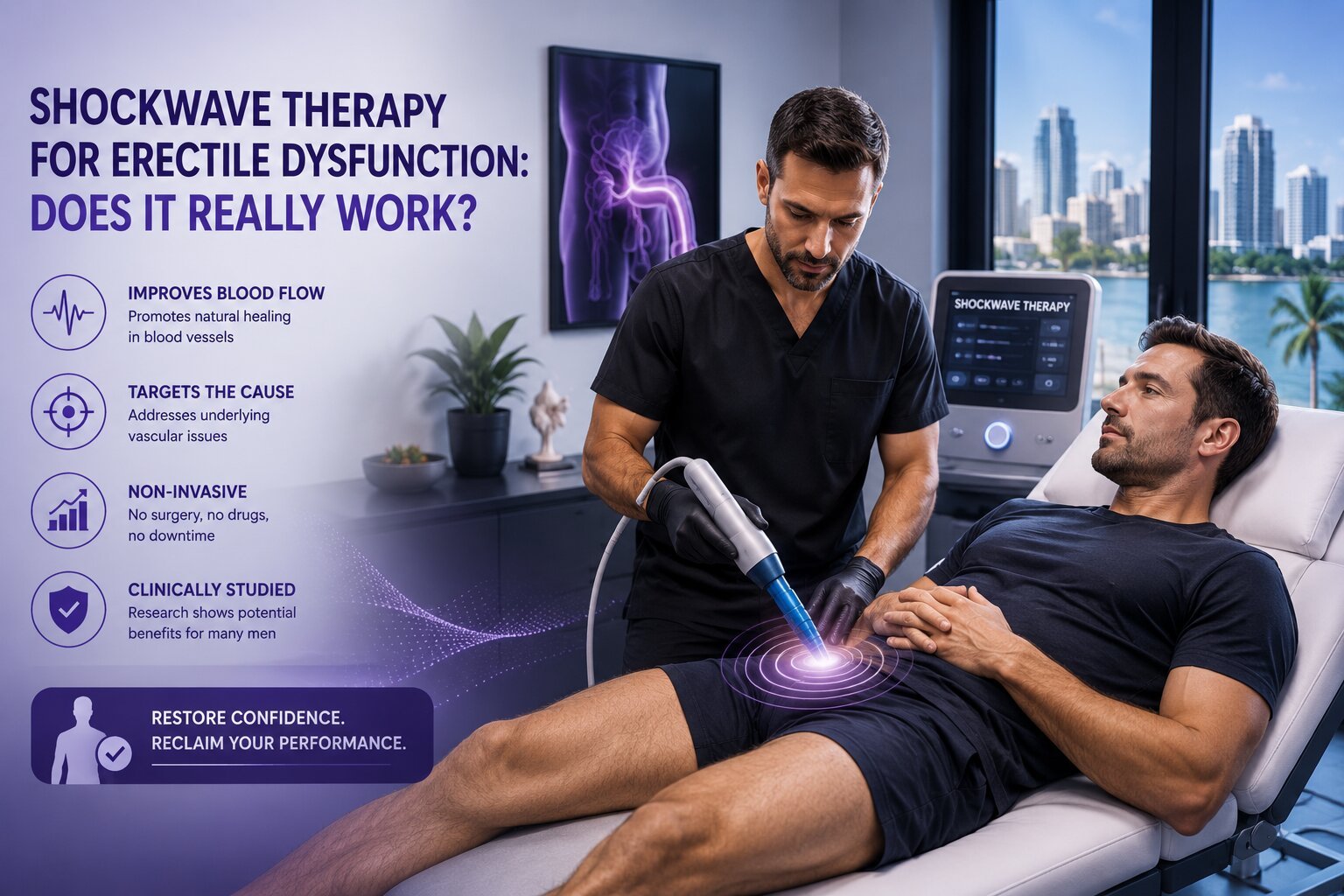
Erectile dysfunction can make a man question almost everything about his sexual health. Then along comes shockwave therapy for erectile dysfunction, promising to improve blood flow and potentially address one of the underlying causes of ED rather than simply helping with an erection for a few hours. It sounds appealing. But does the science support the excitement?
The honest answer is more interesting than a simple yes or no.
Research suggests that low intensity shockwave therapy may help some men with erectile dysfunction, particularly men whose ED has a vascular or blood flow related cause. At the same time, the treatment still has important limitations. Studies have produced encouraging results, but researchers have also reported differences in treatment protocols, devices, patient groups and long term outcomes. That makes it difficult to promise the same result to every patient.
This distinction matters when you are deciding whether to spend money on treatment. A good ED treatment discussion should not sound like a late night infomercial where every problem mysteriously disappears before the commercial break.
The goal of this guide is to separate what researchers have actually found from what marketing claims sometimes suggest. We will look at how shockwave treatment works, who may benefit, what major medical organizations say, possible risks, costs, alternatives and the questions you should ask before booking a consultation. Most importantly, if you are considering shockwave therapy for ED, the decision should start with understanding why you have erectile dysfunction in the first place.
What Is Shockwave Therapy for Erectile Dysfunction?
Shockwave therapy for erectile dysfunction usually refers to low intensity extracorporeal shockwave therapy, often abbreviated as Li-ESWT. Unlike the high energy shockwaves used to break kidney stones, this treatment uses much lower energy levels and targets tissue in the penis with acoustic waves.
The idea behind the treatment is quite different from taking a conventional ED medication. Medicines such as sildenafil and tadalafil work by helping the normal erection process continue when sexual stimulation occurs. Shockwave therapy has been investigated as a treatment that may influence the underlying tissue environment and blood supply.
Researchers have proposed several biological mechanisms. These include stimulating cellular responses, promoting blood vessel related changes and potentially improving blood flow within erectile tissue. The theory is particularly interesting because vascular problems play an important role in many cases of erectile dysfunction.
However, a proposed mechanism is not the same thing as a proven clinical outcome.
That is one of the most important points to understand before considering treatment. A treatment can have an interesting biological theory behind it and still require better clinical evidence before doctors can confidently recommend it to everyone.
Clinical trials have investigated low intensity shockwave therapy in men with ED, with several studies reporting improvements in erectile function scores. Some systematic reviews and meta analyses have also found potential benefits. Yet the evidence is not perfectly consistent, and researchers have repeatedly pointed out differences in treatment methods and study quality. So, what exactly happens when those acoustic waves reach penile tissue?
How Low Intensity Shockwaves Are Used
During treatment, a clinician places a specialized device against several areas of the penis. The device delivers controlled acoustic waves to the targeted tissue. The treatment is generally performed in an outpatient setting, meaning there is usually no hospital stay involved.
The exact protocol can vary considerably. Different studies have used different devices, energy levels, numbers of shockwaves and treatment schedules. This variation is one reason you should be cautious when someone quotes a single impressive success rate as though it applies to every machine and every patient. It may not.
A legitimate consultation should involve more than someone pointing a device at the penis and pressing a button. The clinician should first assess your erectile dysfunction, medical history, medications, cardiovascular risk factors and other relevant health issues.
That assessment matters because ED is not always just a sexual problem. Erectile dysfunction can be associated with diabetes, high blood pressure, obesity, smoking, cardiovascular disease, hormonal problems, neurological conditions, medication effects and psychological factors.
In some men, ED can even be an early warning sign of cardiovascular disease. That is why a responsible treatment plan starts with the patient, not the machine.
How Does Shockwave Therapy Work for ED?
The proposed mechanism behind shockwave therapy for ED centers largely on tissue response and blood flow.
An erection depends on a coordinated process involving the brain, nerves, hormones, blood vessels and erectile tissue. When sexual stimulation occurs, nerves signal the blood vessels supplying the penis to relax. Blood then enters the erectile bodies, while the normal venous outflow becomes restricted. The result is increased pressure within the penis and, when everything works properly, an erection.
When blood vessel function is impaired, that process can become less effective. This is why vascular health matters so much in erectile dysfunction. Conditions such as diabetes, hypertension, smoking and atherosclerosis can damage blood vessels and interfere with the ability to achieve or maintain an erection.
Low intensity shockwave therapy has been studied because researchers believe the acoustic waves may trigger biological responses that could support vascular function and tissue repair. That sounds promising, but there is an important scientific distinction here.
Researchers are still studying exactly how much of the proposed biological response translates into meaningful improvements in sexual function. Laboratory findings can help explain why a treatment might work, but clinical trials are needed to determine whether patients actually experience better erections.
The Role of Blood Flow and New Blood Vessel Formation
One of the most discussed concepts surrounding shockwave therapy is angiogenesis, which means the formation of new blood vessels.
Preclinical research has suggested that low intensity shockwaves may influence signaling pathways involved in vascular growth and tissue repair. Researchers have therefore investigated whether this process could improve blood supply to erectile tissue. This is particularly relevant to men whose ED has a vascular component.
But again, the science needs careful interpretation. Saying that a treatment may promote vascular changes is not the same as saying that it will create enough new functional blood vessels to reverse erectile dysfunction. Human clinical research provides the more useful test.
Several randomized controlled trials and systematic reviews have reported improvements in erectile function following low intensity shockwave treatment. Some studies have also suggested that improvements can persist beyond the immediate treatment period.
The problem is that researchers have not used one universal treatment recipe. One study might use a particular device and energy setting, while another uses a different protocol. The number of treatment sessions can differ as well. Patient characteristics also vary. Some studies focus on men with predominantly vasculogenic ED, while others include broader groups.
That makes comparisons difficult. Think of it like testing a recipe when every chef changes the ingredients. If several chefs produce a good meal, you can reasonably suspect that the recipe has potential. But you cannot yet say that every version will taste identical. For patients, this means shockwave therapy should be viewed as a potential treatment option for selected men, not as a guaranteed biological reset button.
Does Shockwave Therapy Really Work for Erectile Dysfunction?
So here is the question most men actually want answered: does shockwave therapy really work for erectile dysfunction?
Based on current clinical evidence, it appears that low intensity shockwave therapy can improve erectile function in some men, particularly those with vasculogenic ED. Several clinical studies and systematic reviews have reported statistically significant improvements in measures such as the International Index of Erectile Function.
That is the encouraging part. The less exciting, but equally important, part is that the evidence does not support promising a guaranteed cure.
The American Urological Association has historically considered low intensity extracorporeal shockwave therapy investigational for erectile dysfunction. The Sexual Medicine Society of North America has also emphasized that restorative therapies such as shockwave treatment should be approached carefully because evidence and standardization remain issues.
European guidance has been somewhat more open to the treatment in selected patients. European Association of Urology guidance has discussed low intensity shockwave therapy as a possible option for men with mild vasculogenic erectile dysfunction, with the strength of recommendation reflecting the limitations of available evidence.
That difference between professional organizations tells you something useful. The scientific conversation is not simply, "This treatment works," or, "This treatment does nothing." The more accurate position is that there is promising evidence, but important uncertainties remain.
What Clinical Research Actually Shows
Clinical trials have generally focused on men with erectile dysfunction related to impaired vascular function. Researchers commonly measure erectile function using validated questionnaires such as the International Index of Erectile Function or its erectile function domain.
Some randomized controlled trials have found that men receiving low intensity shockwave therapy experience improvements compared with baseline measurements. Meta analyses have also reported improvements in erectile function scores. However, the size of the benefit varies between studies.
A major challenge is treatment standardization. Researchers have used different machines, treatment energies, application sites and schedules. Some protocols involve multiple sessions over several weeks. Others use different treatment frequencies.
The population being studied also matters. A man with mild vascular ED may respond differently from a man with severe diabetes, extensive vascular disease, nerve damage after prostate surgery or major psychological contributors to ED. It would be misleading to take results from one patient group and apply them automatically to everyone.
Another issue is long term evidence. Some studies suggest benefits can continue for months after treatment, but researchers still need stronger and more standardized long term data to establish how durable the effect is and which patients are most likely to maintain an improvement.
This is why a good consultation should focus on your individual diagnosis rather than simply asking whether shockwave therapy "works." The better question is: Is there good reason to believe this treatment could help someone with my specific type of erectile dysfunction?
Which Men May Benefit Most From Shockwave Therapy?
The men most likely to be considered for shockwave therapy for erectile dysfunction are generally those with a vascular component to their ED, especially men with mild to moderate vasculogenic erectile dysfunction.
That does not mean everyone in this category will respond. It means the existing research provides a more logical reason to investigate the treatment in this group.
Vasculogenic ED occurs when problems involving blood vessels or blood flow contribute to difficulty getting or maintaining an erection. Diabetes, hypertension, smoking, high cholesterol, obesity and cardiovascular disease can all contribute to vascular dysfunction. A doctor may also consider the overall severity of your ED and whether standard treatments have worked.
Your medication history matters too. So does your cardiovascular health. If you have developed persistent erectile dysfunction, simply choosing a treatment based on an advertisement can miss the bigger picture. Your clinician may want to evaluate blood pressure, blood glucose, cardiovascular risk, medications, testosterone when clinically appropriate and other factors depending on your history.
This is particularly important because ED can sometimes appear before obvious symptoms of cardiovascular disease. Shockwave therapy should therefore fit into a broader health assessment rather than replace one. A man may walk into a clinic asking about shockwave treatment and discover that his biggest opportunity for improving sexual function involves controlling diabetes, quitting smoking, increasing physical activity, reviewing medication or addressing cardiovascular risk.
What Do Major Medical Guidelines Say About Shockwave Therapy?
Medical guidelines are useful because they help separate promising research from treatments that have become established standards of care. When it comes to shockwave therapy for ED, professional organizations do not all use identical language, but their positions share an important theme: the treatment deserves scientific attention, yet it should not be marketed as a guaranteed cure.
European Guidance
The European Association of Urology has recognized low intensity shockwave therapy as a potential treatment option in selected men with erectile dysfunction, particularly men with mild vasculogenic ED. The recommendation is cautious rather than enthusiastic. That distinction matters. European guidance reflects the fact that clinical research has produced encouraging findings, while also acknowledging limitations in the evidence. Patient selection therefore remains important.
American Guidance
The American Urological Association has taken a more cautious position, describing low intensity extracorporeal shockwave therapy as investigational. The Sexual Medicine Society of North America has similarly urged caution around restorative therapies for sexual dysfunction, emphasizing the need for better evidence, appropriate clinical research and informed patient decision making. For someone considering treatment, these positions provide a useful reality check. If a clinic tells you that shockwave therapy is a universally proven cure for ED, that claim goes beyond what the evidence and major professional guidance currently support.
Is Shockwave Therapy FDA Approved for Erectile Dysfunction?
This is an especially important question before spending money on treatment. In the United States, low intensity shockwave therapy for erectile dysfunction should not be confused with FDA approved treatments for ED.
The FDA has not established low intensity shockwave therapy as an approved standard treatment for erectile dysfunction in the same way that established therapies have received regulatory approval for their specific indications.
That means patients should pay close attention to how clinics describe their devices and services. A device being available in a clinic does not automatically mean that the FDA has approved that device specifically to treat erectile dysfunction.
If a clinic claims that its shockwave device is "FDA approved for ED," ask for the exact regulatory indication and documentation. A trustworthy provider should be willing to explain what the device is authorized or cleared to do rather than relying on a vague regulatory sounding phrase. You should also ask whether your treatment is being provided as part of a clinical trial or as an established clinical service. Those are not the same thing.
What Happens During a Shockwave Therapy Session?
A typical shockwave therapy for ED session takes place in an outpatient clinical environment. The clinician usually positions the shockwave applicator against specific areas of the penis and delivers a series of low intensity acoustic pulses. The exact treatment approach depends on the device and protocol being used.
The procedure does not involve surgery. Patients generally remain awake during treatment, and there is usually no recovery period comparable to a surgical procedure. Many treatment protocols involve repeated sessions rather than one appointment. You should not assume that every clinic follows the same schedule.
This is important because treatment protocols have varied substantially across clinical research. A responsible provider should explain the specific device, treatment parameters, number of sessions and evidence supporting that particular approach. The consultation should also include a discussion about what happens if the treatment does not work. Before paying for a package, ask whether the clinic offers reassessment, what outcome they consider meaningful and what alternative treatments remain available.
How Many Shockwave Therapy Sessions for ED Are Usually Needed?
There is no single universally accepted number of shockwave therapy sessions for ED. Clinical studies have used different treatment schedules. Many protocols involve several sessions spread across multiple weeks, but the exact number depends on the device, treatment protocol and clinical setting.
This variation is another reason to be skeptical of statements such as "six sessions always cure ED." Medicine rarely works that neatly.
The number of sessions should be based on the protocol being used and the clinical evidence behind it. Your clinician should explain what evidence supports the schedule they recommend. You should also ask whether the clinic uses the same protocol that has been studied in peer reviewed clinical research. If a provider cannot clearly explain what device they use, how they determine treatment settings or why their protocol differs from published research, consider getting another opinion.
Does Shockwave Therapy Hurt or Have Side Effects?
One reason men find shockwave therapy for erectile dysfunction appealing is that it does not require surgery. Low intensity treatment is generally described as well tolerated in clinical studies. Some patients may experience temporary discomfort, sensitivity, redness or bruising in the treated area, although reported adverse effects have generally been limited in many studies.
However, "generally well tolerated" does not mean "risk free." Your individual health situation matters. A clinician should review your medical history, medications and any conditions that could affect treatment. You should also tell the provider about other treatments you are using for ED.
Another important point is that long term safety data are not as extensive as the evidence available for established ED treatments. That does not mean shockwave therapy is dangerous. It means the evidence base is still developing, and patients deserve accurate information about that uncertainty. Medical treatment is rarely about guarantees. It is about balancing potential benefits, known risks, uncertainty and alternatives.
Shockwave Therapy vs Viagra and Other ED Treatments
Comparing shockwave therapy for erectile dysfunction with Viagra can be confusing because the two treatments work in very different ways. Sildenafil, the active ingredient in Viagra, belongs to a group of medicines called phosphodiesterase type 5 inhibitors, or PDE5 inhibitors. These medicines improve the normal erectile response by increasing the effect of nitric oxide signaling when a man becomes sexually stimulated.
Shockwave therapy takes a different approach. Researchers have investigated it as a treatment that may influence penile tissue and blood vessel function over time. In other words, Viagra is primarily a medication that helps the erection process work when you need it, while shockwave therapy is being studied as a possible treatment that could produce longer lasting changes in erectile tissue.
PDE5 inhibitors have a much larger evidence base and are established treatments for many men with erectile dysfunction. They have been studied extensively, and clinical guidelines commonly recommend them as a first line treatment when appropriate. Shockwave therapy has promising research behind it, but professional organizations remain more cautious because researchers still need stronger evidence and greater standardization.
Rather than asking which treatment is universally best, ask which treatment makes sense for your cause and severity of ED. A doctor can help determine whether medication, lifestyle changes, another established treatment, shockwave therapy or a combination deserves consideration.
Shockwave Therapy vs Penile Injections
Penile injections are another established option for men who do not achieve satisfactory results with oral ED medication. These medicines directly promote an erection by acting on penile blood vessels and smooth muscle. The mechanism is therefore very different from shockwave therapy.
Injection therapy can produce an erection relatively quickly, which is one reason it remains an important option in sexual medicine. Its effectiveness can be high when prescribed and used correctly. Shockwave therapy does not work as an on demand erection treatment. If it helps, the intended benefit is more gradual. A man cannot reasonably expect to receive a session in the afternoon and then use it like an injection that evening.
If your primary concern is getting a reliable erection for sexual activity in the near term, established treatments may offer a more predictable approach. If you are interested in a potentially restorative treatment and have vascular ED, you may want to discuss the evidence surrounding shockwave therapy with a qualified clinician. The two approaches are not necessarily competitors in every case.
Can Shockwave Therapy Cure Erectile Dysfunction Permanently?
The word cure deserves careful attention. At present, it would be inappropriate to tell every man that shockwave therapy can permanently cure erectile dysfunction. Research has found encouraging improvements in erectile function among some treated men, but that does not establish a permanent cure for all causes of ED.
Erectile dysfunction is a symptom with many possible causes. If diabetes contributes to your ED, treating the underlying metabolic problem remains important. If smoking is damaging your vascular health, stopping smoking can be a meaningful part of treatment.
Researchers have reported benefits that persist beyond the treatment period in some studies, which is one of the reasons shockwave therapy remains an active area of research. However, studies differ in design, treatment protocols and follow up periods. Researchers still need more high quality evidence to establish exactly how long benefits last and which patients maintain them. Instead of asking a clinic, "Will this permanently cure my ED?" ask, "What evidence do you have for men with my diagnosis, and how long were the benefits observed in those studies?"
What Factors Can Affect Your Results?
The response to shockwave therapy for ED can depend on factors related to both the underlying disease and the treatment itself. The cause of your erectile dysfunction is particularly important. Research has focused heavily on men with vascular ED, so the evidence may not apply equally to men whose difficulties primarily result from neurological damage, major hormonal abnormalities, certain medications or psychological factors.
Overall cardiovascular health can also matter. High blood pressure, diabetes, abnormal cholesterol, obesity and smoking can all contribute to vascular dysfunction. Lifestyle factors therefore deserve attention even if you pursue shockwave treatment.
Treatment quality may also influence outcomes. Because clinical studies have used different devices and protocols, you should ask exactly what technology the clinic uses and what evidence supports its protocol. A clinic should be able to explain the treatment without hiding behind vague claims such as "advanced regenerative technology."
Is Shockwave Therapy Safe for Every Man With ED?
No treatment should be assumed to be appropriate for every man. Before considering shockwave therapy for erectile dysfunction, you should have an appropriate medical assessment.
A doctor may ask about your sexual symptoms, medical history, medications, cardiovascular risk factors and lifestyle. That evaluation can identify conditions that deserve treatment regardless of whether you ultimately choose shockwave therapy. It also helps establish whether your ED is likely to have a vascular component.
Be careful with clinics that encourage you to purchase large treatment packages before completing a proper assessment. A professional medical service should explain expected benefits, limitations, alternatives and costs before asking you to commit.
How Much Does Shockwave Therapy for ED Cost?
The cost of shockwave therapy for ED varies substantially by country, clinic, device, treatment protocol and number of sessions. There is no reliable universal price that applies to every patient.
Before paying anything, ask for the total expected cost. You should also ask how many sessions the clinic recommends and whether additional sessions may be suggested later. If a provider recommends substantially more treatment than the protocol used in the research you have reviewed, ask why.
Cost matters because shockwave therapy for ED may not be covered by insurance when it is considered investigational or when it does not meet a payer's coverage criteria. The more useful question is whether the provider offers medically appropriate evaluation, transparent pricing, qualified clinical care and an evidence based explanation of what the treatment can realistically accomplish.
How to Choose a Clinic for Shockwave ED Treatment
Choosing the right provider is one of the most important decisions you can make if you are considering shockwave therapy for erectile dysfunction. Start by checking who will actually evaluate and treat you. Look for an appropriately qualified medical professional with relevant experience in erectile dysfunction and sexual medicine.
Next, ask what device the clinic uses. Do not settle for the phrase "medical grade shockwave machine." Ask for the manufacturer and model and whether the device has an authorization or clearance that specifically relates to the way the clinic is using it.
Watch for red flags. Be cautious if a clinic guarantees a cure, claims that every man responds, dismisses established ED treatments, pressures you to buy a large package immediately or suggests that shockwave therapy can treat every possible cause of erectile dysfunction. The best ED clinic should not try to sell you one treatment before understanding the problem.
Questions to Ask Before Starting Treatment
Before beginning shockwave therapy for ED, take a few minutes to prepare questions for your consultation. Ask what type of erectile dysfunction you have and what evidence suggests shockwave treatment could help your particular case. Ask what device will be used, what treatment protocol is recommended and how that protocol relates to published clinical research.
Ask how the clinic measures improvement and what happens if treatment does not work. If the answers are vague, ask for clarification. If you still cannot get clear answers, consider another opinion. Your sexual health deserves the same level of care you would expect for any other medical issue.
When Should You See a Doctor About Erectile Dysfunction?
You should consider speaking with a healthcare professional when erectile difficulties are persistent, recurrent or causing concern. Occasional difficulty getting an erection can happen to almost anyone. Repeated problems are different. If you regularly struggle to get or maintain an erection that is sufficient for sexual activity, it is worth discussing the issue with a clinician.
A medical evaluation may uncover diabetes, high blood pressure, cardiovascular risk, medication effects, hormonal problems or psychological factors. Addressing those conditions can improve both sexual health and overall wellbeing.
The Bottom Line: Is Shockwave Therapy Worth Considering?
So, does shockwave therapy for erectile dysfunction really work? The evidence suggests that it may improve erectile function for some men, especially those with mild to moderate erectile dysfunction related to vascular problems. Clinical trials and systematic reviews have produced encouraging findings, and the treatment continues to attract significant research interest.
But promising does not mean proven for everyone. Major medical organizations remain cautious because researchers still face important questions about patient selection, treatment protocols, long term effectiveness and standardization.
If you are researching shockwave therapy for erectile dysfunction, do not approach it as a guaranteed cure or a replacement for proper medical evaluation. Approach it as a treatment option worth discussing with a qualified healthcare professional when your individual diagnosis makes the potential benefits relevant.