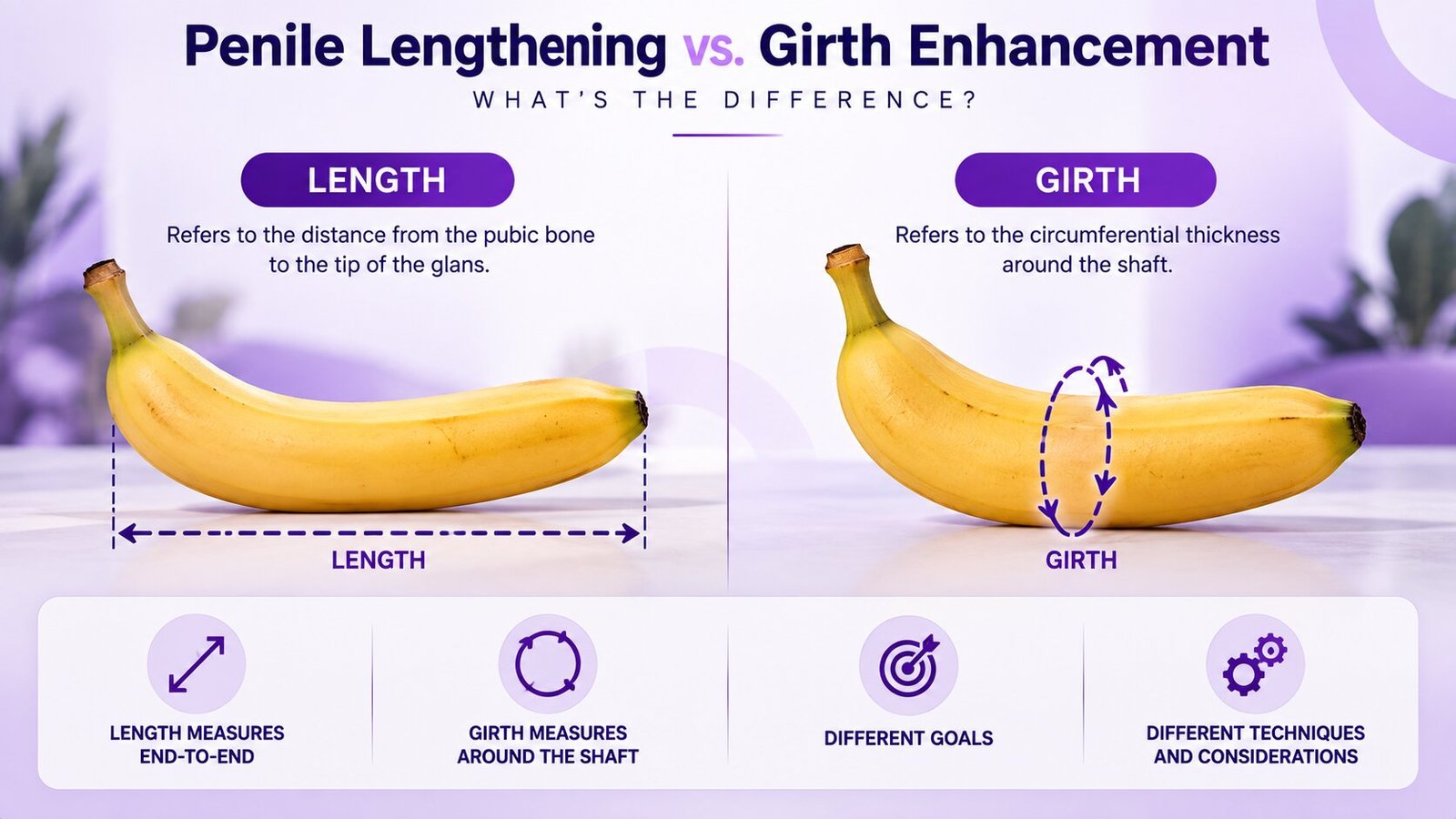
Penile lengthening refers to methods aimed at increasing the longitudinal distance from the pubic bone to the tip of the glans, whereas girth enhancement focuses solely on increasing the circumferential thickness of the shaft. While frequently marketed together under the general label of "enhancement," these two approaches involve entirely different anatomical structures, clinical techniques, evidence levels, and risk profiles.
A critical clinical principle every patient should recognize is that visible penile size is not always identical to anatomical size. Variations in erectile firmness, pre-pubic fat pad thickness, or structural conditions such as Peyronie’s disease can make a penis appear shorter or narrower without any actual loss of internal erectile tissue. A comprehensive medical consultation evaluates these underlying factors first, ensuring patients understand what a treatment can realistically accomplish, what it cannot do, and what clinical risks must be weighed.
A Physician-Led Starting Point
A responsible medical consultation begins with the patient's specific concern rather than a predetermined procedure name. If the concern is perceived loss of length, a physician evaluates flaccid appearance, stretched length, erectile rigidity, curvature, surrounding adiposity, and microvascular blood flow. If the goal is girth, the discussion focuses on specific materials, durability, potential complications, and realistic outcomes.
What Is the Difference Between Penile Length and Girth?
Penile length and penile girth describe two separate biological dimensions:
- Penile Length: The linear distance measured along the dorsal (top) surface of the penile shaft from the pubopenile junction (depressing the pre-pubic fat pad to the pubic bone) to the tip of the glans.
- Penile Girth: The circumference around the penile shaft, commonly measured at the base, mid-shaft, and coronal margin.
Because these dimensions depend on different anatomical structures, modifying one does not automatically increase the other. A cosmetic procedure that adds soft-tissue volume to expand shaft circumference cannot be expected to increase fully erect length unless independent clinical mechanisms support that outcome.
This distinction is especially vital when evaluating promotional before-and-after photographs. While an image can display a fuller or more prominent flaccid appearance, photographs cannot reliably document genuine changes in erect length or circumference without standardized clinical measuring protocols. Ambient temperature, lighting, camera angle, patient positioning, retraction, and erection rigidity can dramatically alter visual appearance.
Why Measurement Matters
Suppose a man notices that his penis appears smaller than it did several years ago. That observation is real and frustrating, but it does not automatically indicate that internal erectile tissue has dissolved or shortened.
If erection rigidity has declined due to age-related vascular changes, the penis cannot achieve its full hydraulic expansion. If weight has accumulated in the lower abdomen, the pre-pubic fat pad may bury part of the shaft. If fibrotic plaque has formed due to Peyronie’s disease, the shaft may retract or curve.
In a formal clinical evaluation, a physician differentiates between:
What Does Penile Lengthening Mean?
Penile lengthening refers broadly to modalities designed to increase measured or visible longitudinal dimensions. The expected clinical outcome depends entirely on whether non-invasive mechanical stretching or surgical intervention is employed.
Traction Devices
Penile traction therapy (PTT) involves wearing an external mechanical device that applies continuous, calibrated stretching force along the shaft. Mechanistically, sustained mechanical tension stimulates cellular mechanotransduction, promoting micro-tissue remodeling and collagen alignment.
Some penile traction devices have shown modest length gains in small clinical studies, with wear schedules and protocols varying significantly by device and study design. In urologic practice, traction has been studied primarily for stabilizing curvature or preventing progressive length loss in men with Peyronie’s disease. Multi-modal protocols, including the P-Long study protocol combining PRP with traction, have investigated these mechanical responses.
However, clinical guidelines from the European Association of Urology (EAU) rate the overall evidence for cosmetic penile lengthening via traction as limited and its recommendation as weak. Traction requires disciplined daily compliance over many months. Improper application or excessive tension can cause skin blistering, pressure ulcers, nerve compression, or temporary numbness.
Suspensory Ligament Surgery
The primary surgical approach to penile lengthening involves the surgical division (release) of the suspensory ligament. This anatomical ligament anchors the base of the penile shaft to the pubic symphysis bone. By surgically severing this tether, a portion of the internal shaft drops forward and hangs lower outside the body.
Crucially, this procedure changes flaccid hanging appearance, not internal erectile tissue length. The American Urological Association (AUA) has stated that division of the suspensory ligament has not been demonstrated to be safe or effective for increasing erect penile length.
Surgical Risks of Suspensory Ligament Division
Releasing the suspensory ligament destabilizes the anatomical foundation of the erect penis. Common complications include loss of erect elevation angle (the erection points downward or feels unstable during intercourse), dense scar tissue re-attaching the penis closer to the pubic bone (causing post-surgical retraction and shortening), infection, and aesthetic dissatisfaction.
Why Might the Penis Look Shorter Without Actually Losing Length?
In many cases of perceived size reduction, the underlying anatomical erectile cylinders remain completely intact, while external health and physiological factors obscure visible dimensions.
Common Causes of Reduced Visible Length
Suprapubic Fat Pad Accumulation
Weight gain in the lower abdomen expands the pre-pubic fat cushion. This creates a "buried" or concealed penis appearance where adipose tissue partially envelops the base of the shaft. Weight loss or targeted pre-pubic defatting uncovers natural length without altering the penis itself.
Diminished Erection Firmness (ED)
If vascular blood flow declines, the erectile chambers cannot achieve maximal hydraulic rigidity. A semi-rigid erection appears noticeably shorter and thinner than a fully rigid one. Addressing underlying erectile dysfunction helps restore full visual dimensions.
Peyronie's Disease & Fibrotic Plaque
Peyronie’s disease can cause curvature, narrowing, and perceived or measured shortening. A patient with a new lump, pain, or changing curvature should have a focused evaluation; treatment depends on the stage and severity of the condition.
Post-Surgical or Pelvic Scarring
Prior pelvic surgeries (such as radical prostatectomy), hernia repairs, or trauma can alter local blood flow and nerve signaling, leading to temporary disuse retraction that requires specialized urologic rehabilitation.
What Does Girth Enhancement Mean?
Girth enhancement focuses exclusively on increasing the circumferential thickness of the penile shaft. The objective is to make the shaft measure larger around, either when flaccid, erect, or both. It does not lengthen the internal erectile cylinders.
Hyaluronic Acid and Other Fillers
Injectable Hyaluronic Acid (HA) fillers are commonly used in non-surgical girth augmentation. HA is a biocompatible sugar molecule naturally present in human connective tissue. When placed in the subdermal space between Dartos fascia and Buck's fascia, HA creates immediate soft-tissue volume expansion.
Because HA is gradually metabolized by the body over a variable period—often estimated between 12 to 24 months depending on the specific product, volume injected, and individual metabolic rate—it is a temporary treatment requiring maintenance. An important safety feature of HA is that it can be dissolved using the enzyme hyaluronidase if nodules, asymmetry, or vascular compromise occur. However, penile filler injections carry risks of bruising, asymmetry, contour irregularities, filler migration toward the base or glans, and rare but severe vascular occlusion.
Fat Transfer, Grafts, and Implants: What Are the Distinctions?
Beyond temporary dermal fillers, several other girth augmentation methods exist. It is essential to distinguish between these interventions, as they involve entirely different biological materials, clinical evidence, and risk profiles:
- Autologous Fat Transfer (Lipoinjection): Fat harvested from the abdomen or thighs via liposuction is processed and injected beneath the penile skin. Fat retention and contour can be unpredictable, with recognized risks of uneven reabsorption, oil cysts, asymmetry, and hard calcified nodules. Major urological guidelines, including the AUA and EAU, note that fat transfer lacks predictable safety and long-term efficacy.
- Acellular Dermal Matrix (ADM) Grafts: Surgical grafting wraps a sheet of processed biological tissue around the erectile cylinders. This invasive procedure requires general anesthesia, extensive incisions, and carries surgical risks of infection, seroma formation, graft contracture, and altered shaft sensation.
- Liquid Silicone & Paraffin Injections (Unapproved): The injection of free liquid silicone, paraffin, or mineral oils is universally condemned by medical authorities. Free liquid substances provoke severe chronic foreign-body reactions (siliconomas/paraffinomas), severe granulomatous inflammation, skin necrosis, ulceration, migration, and permanent disfigurement, frequently requiring radical surgical excision.
- Polymethylmethacrylate (PMMA) Microspheres: PMMA consists of permanent synthetic micro-particles suspended in a carrier gel. Over time, it can cause chronic granuloma formation, hard subcutaneous nodules, contour deformities, and chronic inflammatory pain, with surgical removal being exceptionally difficult without damaging normal erectile structures.
- Subcutaneous Silicone Sleeve Implants: Pre-shaped silicone prostheses surgically placed beneath the shaft skin. While investigated in specialized settings, they carry recognized surgical risks including infection, seroma, mechanical shifting, erosion, painful erections, and the potential need for surgical removal.
Penile Lengthening vs. Girth Enhancement at a Glance
| Feature / Question | Penile Lengthening | Girth Enhancement |
|---|---|---|
| Primary Goal | Increase visible or measured linear length | Increase shaft circumference & thickness |
| Common Methods | Penile traction devices, suspensory ligament release, weight loss | HA dermal fillers, fat grafting, ADM sheets, implants |
| Primary Measurement | Flaccid length, Stretched Penile Length (SPL), erect length | Circumference at base, mid-shaft, and corona |
| Impact on Erect Size | Surgery does not reliably increase erect length; traction may yield modest SPL gains | Adds circumferential volume; does not lengthen the erect penis |
| Medical Context | Peyronie's disease, buried penis repair, post-prostatectomy rehab | Primarily elective cosmetic augmentation |
| Relationship to ED | Does not treat underlying vascular or neurological ED | Does not treat erectile dysfunction |
Can the P-Shot Increase Penile Length or Girth?
The P-Shot uses platelet-rich plasma (PRP) prepared from a patient’s blood. PRP has been studied for erectile dysfunction, but study results are mixed, and it has not been shown to reliably or permanently increase anatomical penile length or girth. Growth factors in PRP are being investigated for possible effects on penile tissue; those proposed mechanisms should not be presented as proven changes in blood vessels or nerves in an individual patient. A firmer erection may change how large the penis appears, but it is different from creating new penile length or circumference. Patients should discuss the limited evidence, alternatives, costs, and risks before treatment.
What Clinical Guidelines Say About Penile PRP
According to clinical guidelines from the European Association of Urology (EAU), findings on PRP for erectile dysfunction are mixed, and evidence remains insufficient for routine clinical use outside of formal clinical research. In men whose erections have lost firmness due to age or mild vascular changes, restorative therapies may help support erectile rigidity, allowing the penis to reach its natural maximum erect expansion. However, PRP is not an anatomical enlargement procedure. Learn more in our clinical review on P-Shot girth and length outcomes.
Why Erectile Dysfunction Can Affect Perceived Size
During a fully rigid erection, the cavernosal sinusoids fill with arterial blood under high pressure, expanding the surrounding collagenous sheath (tunica albuginea) to its maximum physical capacity.
If endothelial dysfunction, cardiovascular plaque, diabetes, or medication side effects reduce arterial inflow, the erection cannot achieve full rigidity. Under suboptimal tumescence, the penis will look and feel substantially smaller in both length and circumference.
Treating the underlying vascular condition with restorative protocols—such as the P-Shot, Shockwave Therapy for ED, or lifestyle optimization—supports natural erectile expansion without requiring cosmetic surgery.
Questions to Ask Before Any Enhancement Procedure
Before agreeing to any penile lengthening or girth enhancement procedure, ask the treating clinician these essential safety questions:
- Which specific measurement will change? Will this change flaccid, stretched, or erect dimensions?
- What exact material or surgical technique is being used? Is the product FDA-approved or cleared for penile application?
- What clinical evidence supports this procedure? Are there peer-reviewed human trials documenting long-term safety?
- How are complications handled? What is the exact protocol if asymmetry, nodules, infection, or vascular compromise occurs?
- Is the result temporary or permanent? If temporary, what is the required maintenance schedule and cumulative cost?
- Should I be evaluated for ED or Peyronie’s disease first? Is an underlying medical condition driving the size concern?
When Should You Seek Medical Evaluation?
A formal medical evaluation is essential if you experience any of the following symptoms:
- Sudden or progressive loss of penile length accompanied by curvature, pain, or a palpable hard lump (signs of Peyronie's disease).
- Difficulty achieving or maintaining sufficient erection rigidity for intercourse.
- Severe pain, skin discoloration, fever, or expanding nodules following any previous cosmetic injection or surgical procedure.
- Persistent distress, anxiety, or body image concerns affecting intimacy and quality of life.
Choosing the Right Medical Starting Point in Miami
For men in Miami, Aventura, Sunny Isles Beach, Fort Lauderdale, and South Florida, the most effective starting point is a confidential medical evaluation focused on health, physiology, and realistic goals.
At P-Shot Miami, Dr. Nina Gupta, MD provides comprehensive assessments that distinguish cosmetic goals from underlying vascular, hormonal, or structural health conditions. Dr. Gupta provides transparent, evidence-based regenerative care with no unsupported claims or high-pressure sales tactics.
Frequently Asked Questions
Medical References & Clinical Guidelines
- European Association of Urology (EAU): Guidelines on Sexual and Reproductive Health — Penile Size Abnormalities and Dysmorphophobia.
- European Association of Urology (EAU): Guidelines on Sexual and Reproductive Health — Management of Erectile Dysfunction (PRP & Regenerative Therapies).
- European Association of Urology (EAU): Guidelines on Sexual and Reproductive Health — Penile Curvature (Peyronie’s Disease).
- American Urological Association (AUA): Guideline Statements on Penile Augmentation and Suspensory Ligament Division.
- Sexual Medicine Society of North America (SMSNA): Position Statements on Penile Augmentation and Injectable Materials.
Conclusion: Start With the Concern, Not the Procedure
Penile lengthening and girth enhancement are frequently grouped together under the broad banner of "penile enlargement," but they address distinct anatomical dimensions with very different clinical realities. Lengthening focuses on linear length, while girth enhancement focuses on circumference. Neither automatically increases the other, and neither represents a standard medical treatment for erectile dysfunction.
When a man notices that his penis looks smaller than it once did, the most valuable first step is identifying why that change occurred. Reduced erection firmness, pre-pubic fat pad expansion, Peyronie's disease, or pelvic scarring can alter visible dimensions without true anatomical tissue loss. Treating the underlying medical condition delivers far more reliable, satisfying, and safe outcomes than rushing into an unproven cosmetic procedure.
For men considering penile wellness options in Miami, prioritize an honest, physician-led evaluation. Understand what has changed, define your goals, examine the clinical evidence, and discuss all potential risks before making a decision.