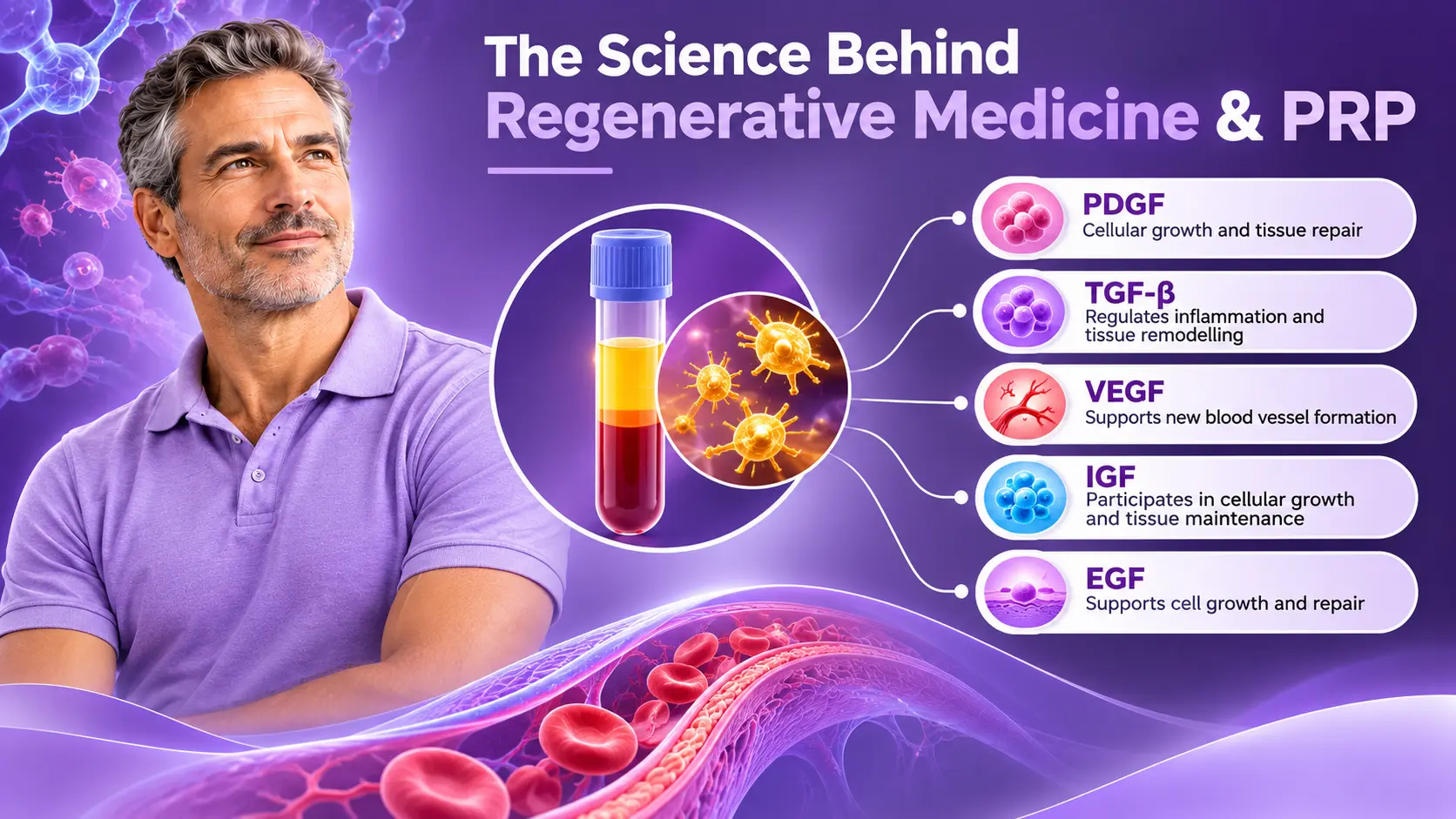
The P-Shot® is increasingly discussed in regenerative medicine, particularly for its potential role in male sexual health. But is it genuinely a regenerative procedure, or is the term simply being used as a marketing phrase? The answer lies in understanding what research says about platelet-rich plasma (PRP) and its ability to support tissue repair.
PRP contains growth factors that participate in cellular repair, tissue healing, and blood vessel development. These biological properties have made it an interesting subject of research for erectile dysfunction and other concerns related to penile health. However, promising biological mechanisms do not automatically translate into proven clinical results.
Let's look at what current PRP research actually shows and whether the P-Shot® deserves to be considered a regenerative treatment.
Having biological growth factors involved in healing mechanisms gives PRP regenerative potential. However, clinical evidence has not yet confirmed that penile PRP injections reliably achieve structural or functional tissue regeneration in humans.
Is the P-Shot® Really a Regenerative Procedure?
The P-Shot® is generally described as a regenerative treatment because it uses PRP, which contains concentrated platelets and growth factors involved in the body's natural healing processes.
The scientific interest comes from the ability of these growth factors to influence cellular activity, tissue repair, and vascular development. Researchers are particularly interested in whether these effects could support the health of penile tissue and improve erectile function.
However, calling the P-Shot® regenerative requires some scientific context. A treatment may stimulate biological processes associated with healing without necessarily producing actual tissue regeneration. This distinction matters because the available clinical evidence has not yet established that PRP can consistently restore damaged penile tissue in humans.
Therefore, the P-Shot® has regenerative potential based on its biological mechanism, but its clinical regenerative benefits remain under investigation.
What Does PRP Research Show?
PRP research has attracted attention because platelets release several growth factors that participate in tissue repair and cellular communication. When activated, concentrated platelets release specialized signaling proteins directly into the local microenvironment.
Some of the most relevant growth factors identified in PRP include:
VEGF
Vascular Endothelial Growth Factor
Associated with blood vessel formation (angiogenesis) and vascular development, which are critical for cavernosal blood supply.
PDGF
Platelet-Derived Growth Factor
Involved in cellular growth, cell division, and tissue repair pathways across smooth muscle and connective tissues.
TGF-β
Transforming Growth Factor-Beta
Participates in tissue remodeling, extracellular matrix regulation, and inflammatory modulation within localized tissue beds.
IGF
Insulin-Like Growth Factor
Supports cellular growth, cell survival, and ongoing tissue maintenance necessary for microvascular integrity.
These growth factors provide a scientific basis for investigating PRP in conditions where tissue health and blood circulation are important.
In erectile dysfunction research, scientists have explored whether PRP could support vascular function, improve endothelial activity, and influence the smooth muscle tissue responsible for erections.
Preclinical studies, particularly animal research, have reported encouraging findings involving tissue changes and erectile responses. Some early human studies have also reported improvements in erectile-function measurements following PRP treatment.
However, the research remains limited. Differences in PRP preparation, treatment protocols, sample sizes, and study designs make it difficult to establish consistent conclusions.
Can PRP Improve Erectile Function?
One of the main research interests surrounding the P-Shot® is its potential effect on erectile function.
A healthy erection depends heavily on adequate blood circulation and the proper functioning of penile vascular tissue. When blood vessels or endothelial function become impaired—due to aging, arterial plaque, or metabolic changes—maintaining an erection can become difficult.
PRP is being investigated because its growth factors may influence biological pathways associated with vascular repair and tissue healing.
Some early clinical findings suggest that PRP injections may improve erectile-function scores in certain patients. However, these results should be interpreted carefully because existing studies are relatively small and do not consistently include strong placebo-controlled comparisons.
It is also important to understand that erectile dysfunction has several possible causes, including:
PRP may not address all these underlying problems. More extensive clinical research is needed to determine which patients, if any, are most likely to benefit.
What Are the Limitations of Current PRP Research?
Although PRP has an interesting biological foundation, there are still important gaps in the scientific evidence:
Preclinical vs. Human Translation
Many encouraging findings come from laboratory experiments and animal models. While these studies help researchers understand possible cellular mechanisms, their results cannot automatically be applied to human clinical care.
Small Study Cohorts
Clinical studies involving penile PRP injections have often included relatively small participant groups. Larger randomized controlled trials are needed to determine whether observed improvements are genuinely caused by PRP rather than placebo effect or natural variation.
Lack of Protocol Standardization
There is no universally standardized PRP preparation or injection protocol. Variations in platelet concentration, centrifuge speed, activation agents, and treatment schedules can significantly influence research outcomes.
Insufficient Long-Term Data
Long-term evidence remains insufficient. Researchers still need to establish how durable any potential benefits may be, whether repeated treatments are appropriate, and what maintenance schedules are safe and effective.
These limitations explain why major medical bodies view the treatment cautiously. The American Urological Association (AUA) classifies penile PRP injections as experimental, and the 2026 Sexual Medicine Society of North America (SMSNA) position statement recommends against routine clinical PRP use outside institutional review board (IRB)–approved clinical trials until convincing clinically meaningful efficacy is proven.
Is the P-Shot® Proven to Regenerate Penile Tissue?
This is where it is important to separate scientific possibility from established evidence.
PRP contains growth factors that participate in natural tissue-repair processes. Research suggests these substances may influence cellular signaling, vascular development, and tissue remodeling.
However, there is currently insufficient high-quality human evidence to confirm that the P-Shot® regenerates penile tissue or permanently restores its normal function.
A regenerative treatment should ideally demonstrate measurable improvements in tissue structure or function, supported by reliable clinical research. For the P-Shot®, this level of evidence has not yet been established.
Consequently, describing it as a PRP-based treatment with regenerative potential is more scientifically accurate than claiming that it is a proven penile regeneration procedure.
What Is the Current Scientific Perspective?
The current scientific perspective is cautiously optimistic but not conclusive.
PRP has biological properties that make it worth investigating in regenerative medicine. Its growth factors are involved in processes that may be relevant to penile vascular health and tissue repair.
However, promising mechanisms are only the starting point of clinical research. Treatments must demonstrate safety, effectiveness, and consistent outcomes in well-designed human studies before they can be considered established medical therapies.
For erectile dysfunction, established treatments such as PDE5 inhibitors, including sildenafil and tadalafil, have substantially stronger clinical evidence than PRP injections.
Patients considering the P-Shot® should understand its investigational status and discuss appropriate treatment options with a qualified physician.
Conclusion: Understanding the True Status of the P-Shot®
So, is the P-Shot® a regenerative procedure? Scientifically, it has regenerative potential, but its clinical effectiveness as a penile regeneration treatment has not yet been proven.
PRP contains growth factors associated with tissue repair, vascular development, and cellular activity. Early research provides interesting findings regarding its possible role in erectile function and penile tissue health.
However, current human evidence remains limited, and larger clinical trials are necessary to establish its actual benefits, safety, and long-term effectiveness.
The most accurate way to describe the P-Shot® today is as an investigational PRP-based treatment being studied for its potential regenerative effects, rather than a scientifically established penile regeneration therapy.
Frequently Asked Questions
Physician-Performed Men's Health Consultations in Miami
Understanding whether a regenerative procedure fits your personal goals begins with a thorough medical consultation. At P-Shot® Miami, Dr. Nina Gupta, MD, ABAARM, FAARM, brings over 37 years of clinical medical experience to individualized men's sexual health assessments.
Dr. Gupta is board certified in Anti-Aging and Regenerative Medicine, an active member of the American Academy of Anti-Aging Medicine (A4M), and has been listed in the official Cellular Medicine Association Priapus Shot® provider directory since January 2017. Consultations focus on comprehensive diagnostic evaluation, medical history, cardiovascular health, and discussing established therapies alongside investigational options.
If you are located in Miami, Sunny Isles Beach, Bal Harbour, North Miami, Fort Lauderdale, or surrounding South Florida communities, call or text 305-521-8522 to arrange a private consultation.
This article is published strictly for educational and informational purposes and does not constitute formal medical advice, diagnosis, or clinical recommendation. Platelet-rich plasma (PRP) therapy for erectile dysfunction is investigational; clinical outcomes cannot be guaranteed and individual results vary. Always consult a qualified physician regarding symptoms, underlying cardiovascular or metabolic conditions, and appropriate evidence-based treatment plans.
- American Urological Association (AUA). Erectile Dysfunction Guideline. Classifies platelet-rich plasma (PRP) as experimental for erectile dysfunction. AUA Clinical Guidelines.
- Sexual Medicine Society of North America (SMSNA). Position Statement on Restorative Therapies for Erectile Dysfunction (2026). Recommends against routine clinical PRP use outside IRB-approved clinical trials. SMSNA Position Statements.
- European Association of Urology (EAU). Guidelines on Sexual and Reproductive Health. Management of Erectile Dysfunction and Investigational Therapies. EAU Guidelines.
- Epifanova MV, Gvasalia BR, et al. Platelet-Rich Plasma Therapy for Male Sexual Dysfunction: Myth or Reality? Sex Med Rev. Review of preclinical and clinical evidence on growth factor signaling in erectile tissue.
- National Institute of Diabetes and Digestive and Kidney Diseases (NIDDK). Erectile Dysfunction: Symptoms, Causes, and Evidence-Based Treatments. NIDDK Health Information.