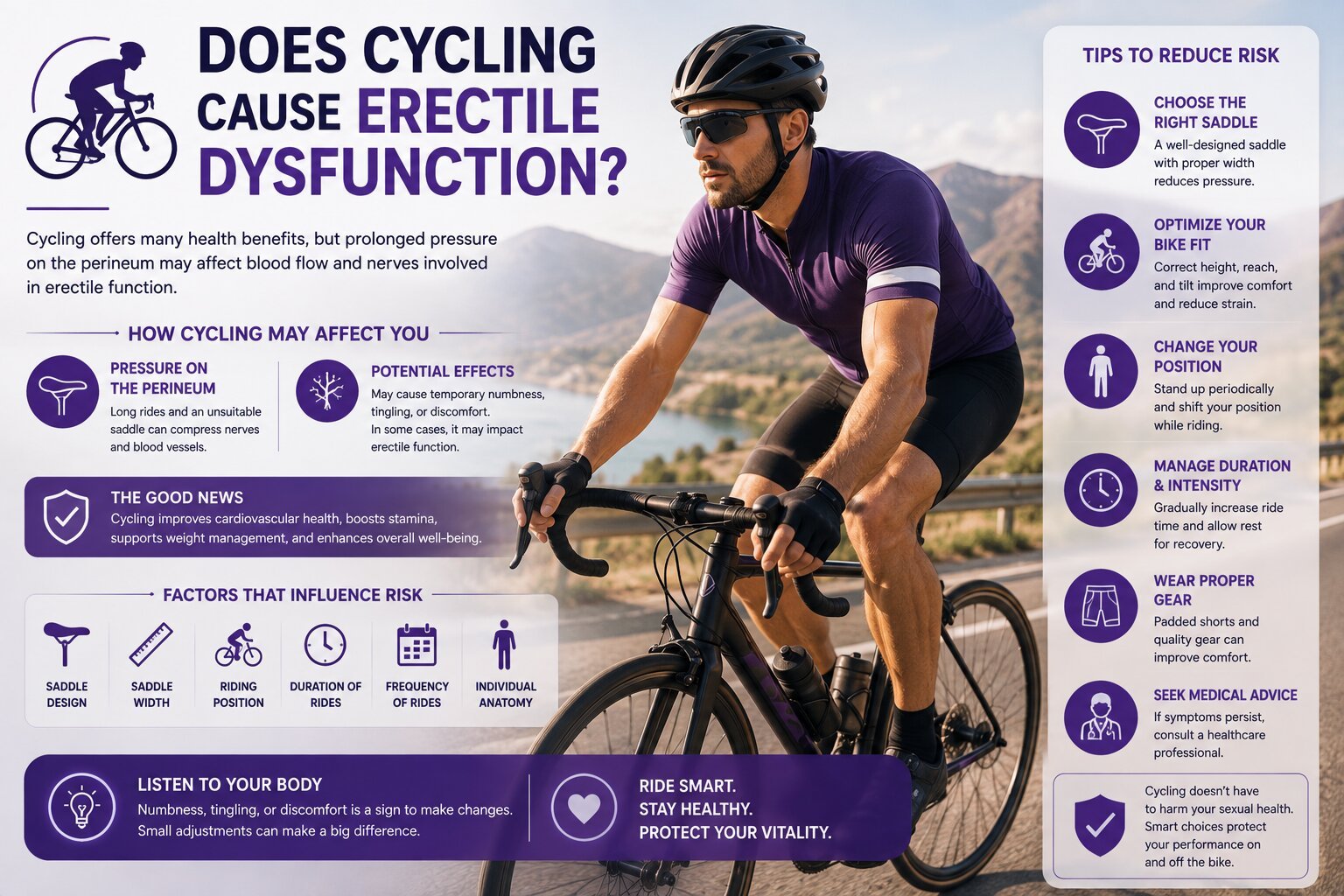
Cycling is one of those exercises that seems to do a little bit of everything. It can strengthen your legs, improve cardiovascular fitness, help with weight management, and give you a practical way to stay active without spending hours in a gym. For many men, cycling is also a hobby, a sport, or simply an enjoyable way to get around. So when questions arise about cycling and erectile dysfunction (ED), it is understandable that riders may wonder whether something they enjoy could be affecting their sexual health.
The answer is not as simple as saying that cycling causes erectile dysfunction. Research has suggested that prolonged cycling may place pressure on the perineum, the area between the genitals and anus. Depending on the saddle, riding position, duration of the ride, and individual anatomy, that pressure may affect blood vessels and nerves involved in penile sensation and erectile function. Some cyclists experience temporary genital numbness or tingling, while others may notice discomfort after particularly long rides.
That does not mean every cyclist is at risk of developing ED. In fact, cycling itself has many health benefits, and the available research has not established that ordinary cycling inevitably causes permanent erectile dysfunction. The more useful question is often: How are you cycling, and what is your body telling you while you ride? A man who occasionally rides for half an hour is in a very different situation from someone who spends several hours on a bicycle every weekend or trains for endurance events.
The good news is that many factors connected with saddle pressure can be changed. Saddle design, saddle width, bike fit, riding posture, training duration, and how often you stand up can all influence the amount of pressure placed on the perineal area. Paying attention to symptoms such as numbness is also important. If genital numbness repeatedly occurs during or after cycling, it should not simply be dismissed as an unavoidable part of the sport.
How Cycling May Affect Erectile Function
To understand why people ask whether cycling causes erectile dysfunction, it helps to look at what happens when a man sits on a bicycle saddle. Unlike sitting on a normal chair, cycling places the body in a particular position while the rider is also moving, leaning forward, pedaling, and repeatedly transferring weight through the pelvis. Depending on the type of bicycle and riding posture, part of that pressure can be concentrated around the perineum. This is especially relevant because the perineal region contains nerves and blood vessels that contribute to normal sexual sensation and erectile function.
When pressure is applied to this area for a prolonged period, blood flow may temporarily be reduced. Nerves can also become compressed, which may lead to altered sensation. You may have experienced something similar after sitting awkwardly on your leg for too long: eventually, the area feels numb or tingly, and normal sensation gradually returns after you move. The perineum can respond to pressure in a comparable way, although the structures involved are different and the consequences can be more important when the pressure is repeated regularly.
One of the main concerns is compression of the pudendal nerve. This nerve is involved in sensation in the genital and perineal regions and also plays a role in aspects of sexual function. Another concern is pressure on blood vessels supplying the penis. An erection depends heavily on adequate blood flow, so anything that repeatedly interferes with normal circulation deserves attention.
This does not mean a bicycle is automatically harmful. The human body is remarkably adaptable, and many cyclists ride for years without developing erectile problems. The issue is more about prolonged, repeated pressure and how the bicycle distributes your weight. If your saddle is poorly fitted, your position forces excessive weight onto the front of the saddle, or you remain seated for very long periods without changing position, the amount of pressure may increase.
That is why genital numbness can be a useful warning signal. If your hands became numb every time you rode, you would probably adjust your handlebars or riding position rather than simply accepting it. The same principle applies to your pelvic area. Cycling should not routinely leave your penis or perineum numb.
What Happens to Blood Flow During Cycling?
Blood flow is central to understanding the possible connection between cycling and erectile dysfunction. A normal erection requires blood vessels in the penis to relax and allow increased blood flow into erectile tissue. If the blood supply is temporarily restricted by external pressure, penile oxygen levels and circulation may be affected while that pressure continues. Studies examining cycling have demonstrated that certain riding positions and saddles can reduce measures of penile blood flow or oxygenation, although this does not automatically mean that the temporary change will result in permanent ED.
Think of the blood vessels like flexible garden hoses. If nothing is pressing against the hose, water can move freely. If something repeatedly bends or compresses the hose, the flow can become restricted. A bicycle saddle can create a similar pressure effect when a rider's weight is transferred onto soft tissue rather than being adequately supported by the pelvic bones. The longer that pressure continues, the more relevant it becomes.
Riding position matters here. A cyclist who sits relatively upright may distribute weight differently from someone leaning forward aggressively over drop handlebars. Road cyclists, triathletes, and endurance riders may spend substantial amounts of time in positions where the pelvis rotates forward and the front portion of the saddle receives more pressure. That does not make these cycling styles inherently dangerous, but it means saddle selection and bike fitting become particularly important.
The good news is that temporary changes in blood flow do not necessarily equal permanent damage. Once pressure is removed, circulation can recover. This is one reason why getting out of the saddle periodically can be helpful. Standing on the pedals takes direct pressure away from the perineum and allows compressed tissues to recover.
The bigger concern is repeated symptoms. If a cyclist regularly experiences numbness, tingling, pain, or changes in erectile function, it makes sense to investigate rather than simply continuing the same routine. A bicycle adjustment may solve the problem, but persistent ED can have many causes unrelated to cycling. Cardiovascular disease, diabetes, high blood pressure, obesity, smoking, medication effects, hormonal problems, and psychological factors can all contribute to erectile difficulties.
Why the Pudendal Nerve Matters
The pudendal nerve is one of the key structures involved in the discussion about cycling and sexual health. It travels through the pelvis and supplies sensation to parts of the external genitalia and perineum. It also contributes to the control of certain pelvic floor muscles. Because of its location, prolonged pressure around the perineum can potentially irritate or compress this nerve.
The easiest way to understand nerve compression is to think about what happens when you sit in one position for too long. Perhaps your foot goes numb after sitting cross-legged, or your arm tingles after sleeping on it. The pressure temporarily interferes with normal nerve function. Once you change position and remove the pressure, sensation generally returns. Cycling-related perineal pressure can create a similar type of problem, although repeated compression in the genital region deserves more attention because of the possible effect on sexual sensation.
A cyclist experiencing pudendal nerve irritation might notice penile numbness, perineal numbness, tingling, burning, discomfort, or changes in genital sensation. Some men may also notice that their erections feel different or that it takes more stimulation to achieve the same response. Not every symptom means the nerve has been permanently damaged. Temporary compression can cause temporary symptoms. However, recurring symptoms are a reason to reassess the bicycle setup and, if necessary, seek medical advice.
The important point is that numbness is not something you should deliberately train yourself to tolerate. There is sometimes a culture in endurance sports where discomfort is treated as proof that a workout is working. That mindset can be useful when you are pushing your cardiovascular system or muscles, but it is not a good approach to nerve-related symptoms. Your legs feeling tired after a long ride is expected. Your genitals repeatedly becoming numb is a different matter.
A proper bike fit can help identify whether the saddle is too high, too low, too far forward, or otherwise positioned in a way that increases perineal pressure. Saddle shape and width also matter because the goal is to provide support through the sit bones rather than forcing soft tissue to carry excessive body weight. For cyclists who continue to experience symptoms despite equipment and position changes, a healthcare professional can help determine whether another condition is contributing.
Can Saddle Pressure Lead to Erectile Problems?
The bicycle saddle is often the first thing worth examining when a cyclist experiences genital numbness or worries about erectile dysfunction. After all, it is the part of the bicycle that supports much of your body weight while you are seated. But the issue is not simply whether a saddle is hard, soft, narrow, or padded. What matters is where the saddle places pressure and how it interacts with your anatomy and riding position.
A poorly matched saddle can place pressure on the perineum rather than distributing weight primarily through the sit bones. This can become more noticeable when a cyclist leans forward. As the pelvis rotates, the relationship between the body and saddle changes, potentially moving pressure toward the front portion of the saddle. On a long ride, even a modest amount of pressure can become significant because it is repeated for hours.
Research into cycling and male sexual function has examined these effects using measures such as penile oxygen pressure and blood flow. Findings suggest that some saddles and riding positions can reduce blood flow while pressure is being applied. This helps explain why a cyclist may experience numbness during a ride and then notice normal sensation returning after getting off the bike.
However, it is important not to jump from temporary pressure-related changes to the conclusion that cycling permanently damages erectile function. The human body can recover from short-term compression, and not every man who experiences numbness will develop ED. The risk may depend on several factors working together, including riding frequency, duration, saddle design, bike geometry, posture, body shape, and individual susceptibility.
This is also why replacing a bicycle saddle should not be treated as a one-size-fits-all solution. A saddle that feels comfortable to one cyclist may create pressure points for another. Two men of the same height and weight can have different pelvic anatomy and different riding positions. Professional bicycle fitting can therefore be useful, especially for men who cycle frequently or experience recurring genital symptoms.
If erectile difficulties began around the same time as a major increase in cycling, it is reasonable to consider saddle pressure as one possible factor. But ED deserves a broader evaluation if it persists. Erectile dysfunction can sometimes be an early sign of underlying vascular disease, so blaming every sexual problem on the bicycle could mean overlooking an important health issue.
Why Saddle Design and Width Matter
Saddle design can have a surprisingly large influence on how pressure is distributed during cycling. A saddle that is too narrow may not adequately support the sit bones, while a shape that does not match the rider's pelvic anatomy can shift pressure toward sensitive soft tissue. The front portion of the saddle, often called the nose, can become particularly relevant when the cyclist leans forward or spends long periods in an aggressive riding position.
A properly selected saddle should generally provide stable support without creating excessive pressure in the center of the perineum. Some saddles use a central cutout or pressure-relief channel to reduce contact in this area. Other designs, including no-nose saddles, place much less direct pressure on the perineum. Research has found that no-nose saddle designs can substantially reduce perineal pressure, although they can feel different to ride and may affect stability or handling for some cyclists.
Width is another important consideration. It can be tempting to assume that a narrower saddle is automatically better because it looks more streamlined or sporty. But a saddle that is too narrow may fail to support the pelvic bones properly. If your sit bones extend beyond the supportive area, your body may place more weight on surrounding soft tissue.
At the same time, wider is not automatically better. A saddle that is excessively wide can create friction, interfere with leg movement, or introduce other pressure points. The goal is not to find the biggest or softest seat available. The goal is to find a shape and width that fit your body and your style of riding.
A professional bike fitting can help with this process. A fitter can assess your position, saddle height, pelvic angle, handlebar reach, and other factors that affect how much pressure reaches the perineum. For a cyclist experiencing repeated numbness, investing in a proper fit may be more useful than buying random saddles and hoping one works.
Does More Padding Actually Help?
It seems logical that more padding should protect the perineum. After all, if a hard saddle is uncomfortable, wouldn't a thick, soft saddle solve the problem? Not necessarily. While padding can change how a saddle feels, comfort and pressure distribution are not exactly the same thing.
A very soft saddle can allow the body to sink into the material, potentially increasing contact with areas that you actually want to keep free from excessive pressure. The result may feel comfortable for a short period but become less comfortable during a longer ride. Thick padding can also change your pelvic position and create additional friction as you pedal.
This is why saddle shape, width, and fit can matter more than simply adding cushioning. The saddle should provide stable support through the appropriate pelvic structures while limiting pressure on the perineum. For some cyclists, a relatively firm saddle that fits correctly may be more comfortable and protective than a heavily padded saddle that does not match their anatomy.
You can think of it like a pair of shoes. A very soft shoe is not necessarily a good shoe if it is the wrong size or shape. Your foot may feel cushioned at first, but pressure can develop in the wrong places after several miles. A bicycle saddle works in much the same way: the material matters, but the fit and pressure distribution matter more.
Cyclists should therefore judge a saddle by what happens during a real ride rather than how comfortable it feels for five minutes in a store. Pay attention to pressure, numbness, pain, stability, and how your pelvis feels after an hour or more. If genital numbness appears repeatedly, the saddle and overall bicycle setup deserve attention.
Most importantly, do not assume that discomfort is simply part of becoming accustomed to cycling. Some adjustment during the first few rides is normal, but repeated genital numbness is a signal worth responding to. A properly fitted saddle should allow you to ride without repeatedly compromising sensation in the genital area.
Is Genital Numbness After Cycling Normal?
Genital numbness is one of the clearest symptoms that can connect cycling with pressure on the perineum. Some cyclists notice a temporary loss of sensation during a long ride, while others experience tingling or a strange feeling that remains for a short time after getting off the bicycle. Because this symptom is relatively common among cyclists, it can be easy to assume that it is harmless and simply part of the sport.
But common does not necessarily mean normal or desirable.
Your body uses sensation to communicate when something is under excessive pressure. If your fingers became numb every time you used a particular tool, you would probably change your grip or equipment. If your foot went numb every time you wore a particular shoe, you would likely change the shoe. Genital numbness deserves the same practical response.
Temporary numbness may occur because nerves or blood vessels have been compressed while you are seated. Once you stand up and remove the pressure, normal circulation and nerve function may return. The concern increases when numbness happens frequently, lasts for a long time after cycling, becomes painful, or starts occurring outside of cycling.
The first response does not necessarily need to be giving up your bicycle. Instead, look at the factors creating the pressure. Your saddle may be the wrong width or shape. Your saddle height or angle may be contributing to the problem. Your riding position may place too much weight forward. You may also simply be spending too long continuously seated without changing position.
Reducing the duration of uninterrupted saddle contact can make a difference. Standing periodically, adjusting your position, and taking breaks can remove pressure from the perineum. If symptoms continue despite these changes, a professional bike fitting and medical evaluation are reasonable next steps.
Warning Signs Cyclists Should Not Ignore
Not every unusual sensation after cycling is an emergency, but some symptoms deserve more attention than others. Brief numbness that disappears soon after getting off the bike may be related to temporary pressure. Persistent numbness, worsening symptoms, pain, burning, or changes in sexual function are more important because they may indicate ongoing irritation of nerves or another underlying problem.
Pay particular attention if you notice repeated penile numbness, perineal pain, burning sensations, tingling, reduced genital sensitivity, or erectile difficulties that were not present before. If these symptoms consistently appear during cycling, consider changing the saddle and riding position rather than continuing to ride through them.
It is also important to distinguish cycling-related symptoms from general erectile dysfunction. ED can develop for many reasons. Blood vessel problems, diabetes, high blood pressure, high cholesterol, obesity, smoking, certain medications, hormonal issues, neurological conditions, stress, anxiety, relationship difficulties, and depression can all play a role.
That means a man should not automatically blame his bicycle simply because he happens to cycle. If erectile dysfunction continues even when he is not riding, or if it develops without any clear connection to cycling, a medical evaluation is especially important. Erectile dysfunction can sometimes provide an early clue that cardiovascular or metabolic health needs attention.
A useful rule is simple: listen to your body, but do not diagnose yourself from one symptom. If cycling consistently causes numbness, change the pressure and bike setup. If ED persists, investigate the broader picture with a healthcare professional. You can address the cycling issue and your overall health at same time.
Does Research Link Cycling With Erectile Dysfunction?
The research on cycling and erectile dysfunction is more complicated than a simple yes-or-no answer. Some studies have found an association between frequent cycling and sexual difficulties, particularly among men who spend long periods on the saddle. Other studies have not found a meaningful difference in erectile function between cyclists and non-cyclists. This mixed evidence is important because it means cycling should not automatically be labeled as a direct cause of ED.
One systematic review and meta-analysis looked at several studies involving thousands of cyclists and non-cyclists. The initial analysis did not find a statistically significant difference in erectile dysfunction between the groups. After researchers adjusted for factors such as age and certain medical conditions, however, cyclists showed higher odds of ED. The researchers also pointed out important limitations in the available evidence, including differences in study design and the types of cyclists included.
Why does that matter? Imagine trying to determine whether coffee causes headaches by comparing two groups of people when one group is older, sleeps less, and drinks more coffee than the other. Even if the coffee group has more headaches, it would be difficult to say that coffee alone caused the problem. The same challenge exists with cycling research because cyclists and non-cyclists can differ in age, fitness, weight, health conditions, training habits, and lifestyle.
Another important issue is cycling intensity and duration. A person who rides casually for 30 minutes a few times a week is not exposed to the same amount of saddle pressure as an endurance cyclist who spends several hours riding multiple days a week. Studies that group all cyclists together may therefore miss important differences between recreational riders and high-mileage cyclists.
There is also a distinction between short-term physiological effects and long-term erectile dysfunction. Research has demonstrated that certain cycling conditions can temporarily reduce pressure or oxygenation in penile tissue. That finding is useful because it helps explain symptoms such as numbness. But a temporary reduction in blood flow while sitting on a saddle is not automatically evidence of permanent erectile damage.
The safest interpretation of the evidence is that prolonged perineal pressure may contribute to sexual symptoms in some cyclists, particularly when riding habits and bicycle setup create excessive pressure. However, the evidence does not show that cycling inevitably causes permanent erectile dysfunction.
This distinction is reassuring for most riders. Cycling offers substantial cardiovascular benefits, and regular physical activity is generally considered beneficial for overall vascular health. Rather than abandoning cycling because of fear of ED, cyclists can focus on reducing unnecessary pressure and paying attention to symptoms.
Which Cyclists May Have a Higher Risk?
Not every cyclist has the same exposure to saddle pressure. Someone who rides a bicycle to the local store for 15 minutes occasionally has a very different risk profile from an endurance cyclist who spends four or five hours on the road. Duration, frequency, riding position, saddle design, and individual anatomy can all influence how much pressure reaches the perineal area.
Long-distance cyclists may be more likely to experience problems because the same region can remain under pressure for extended periods. Even if the pressure is relatively mild, several hours of repeated compression can become significant. The situation may be particularly relevant for cyclists who rarely stand on the pedals and spend most of a ride continuously seated.
An aggressive riding position can also change pressure distribution. Road cyclists and triathletes may lean forward substantially, rotating the pelvis and transferring more weight toward the front of the saddle. Again, this does not mean that road cycling or triathlon automatically causes ED. It simply means that cyclists in these positions may need to pay closer attention to saddle design and bike fit.
Training volume is another factor. A sudden jump from occasional weekend rides to several long training sessions every week gives the body less opportunity to adapt. If genital numbness appears after increasing mileage, it is worth considering whether the increase in saddle time happened too quickly.
Certain physical characteristics may also influence pressure. Pelvic anatomy varies considerably between individuals, so there is no universal saddle that is perfect for every man. A saddle that works beautifully for one cyclist may create pressure points for another. This is one reason professional fitting can be useful for riders who experience persistent discomfort.
Of course, cycling is only one piece of the erectile-function puzzle. A man who cycles regularly may also have diabetes, high blood pressure, high cholesterol, obesity, cardiovascular disease, or another condition that affects erections. Smoking and excessive alcohol consumption can also contribute. Certain medications, including some drugs used to treat high blood pressure or depression, may affect sexual function as well.
Psychological factors should not be forgotten either. Stress, anxiety, depression, relationship problems, and performance anxiety can all interfere with erections. Sometimes several factors exist at once. A cyclist may have mild perineal pressure combined with stress and cardiovascular risk factors, making it impossible to blame the bicycle alone.
The practical takeaway is straightforward: the more frequently and intensely you cycle, the more important proper equipment and riding technique become. If you ride regularly and experience genital numbness or sexual changes, those symptoms deserve attention rather than being dismissed as part of being a cyclist.
How to Reduce Perineal Pressure While Cycling
The good news is that you do not necessarily have to choose between cycling and protecting your sexual health. Several simple changes can reduce the amount of continuous pressure placed on the perineum. Sometimes the solution is as straightforward as changing the saddle. In other cases, a professional bike fitting or adjustment to riding habits may be needed.
The first step is to identify what is causing the pressure. Is the saddle too narrow? Is it positioned incorrectly? Are you leaning excessively forward? Are you spending hours without standing? Are you riding through numbness because you assume it is normal?
There is no reason to accept persistent genital discomfort as the price of cycling.
Choose a Properly Fitted Saddle
A good saddle should support your body without putting unnecessary pressure on sensitive soft tissue. The objective is generally to allow the sit bones to carry an appropriate amount of your weight while minimizing pressure through the central perineal region.
Saddle width is particularly important. A saddle that is too narrow may not adequately support the sit bones, potentially shifting more weight toward the perineum. A saddle that is excessively wide can create other problems, including rubbing and interference with normal leg movement. The right width depends on your pelvic anatomy and riding style.
Some saddles include a central cutout or pressure-relief channel. These designs are intended to reduce contact with the perineal area. For some riders, they can improve comfort and reduce numbness. Other cyclists may prefer different shapes, so there is no universal answer.
No-nose saddles are another option. Because they remove much of the front portion of a traditional saddle, they can substantially reduce perineal pressure. However, they change the way the rider is supported and may not be appropriate for every type of cycling.
It is also worth remembering that soft does not always mean better. A heavily padded saddle can feel wonderful for a few minutes but may not distribute pressure effectively during a long ride. A firm saddle with the correct shape and width can sometimes be more comfortable because it provides stable support without allowing the pelvis to sink into the material.
If you have repeatedly experienced numbness, consider having your saddle assessed by a qualified bike fitter rather than buying several different seats at random. Proper fitting can help determine whether your current saddle is contributing to the problem.
Adjust Your Bike and Riding Position
Even a good saddle can cause problems if the rest of the bicycle is poorly adjusted. Your saddle height, saddle angle, saddle position, handlebar height, and reach all influence how your weight is distributed.
For example, a saddle that is positioned too high may cause you to rock from side to side while pedaling. A saddle that is too low may alter your knee and hip position. A saddle that is tilted incorrectly may also shift your body weight in a way that increases pressure toward the front.
Handlebar position matters because it influences how far you lean forward. If the handlebars are too low or too far away for your body, you may spend more time in an aggressive posture. That can increase the amount of weight transferred toward the front of the saddle.
This is why changing only the saddle does not always solve the problem. The bicycle works as a system. Your feet, legs, hips, spine, arms, hands, and pelvis all interact while you ride.
A professional bicycle fitting can assess these relationships. This may be particularly worthwhile if you cycle frequently, participate in long-distance events, or repeatedly experience numbness despite changing your saddle.
You should also pay attention to how you feel during the ride rather than waiting until you get home. If you notice pressure building in the perineal region, adjust your position. Move slightly, change your posture, or stand briefly. Small changes made early may prevent prolonged compression.
Stand Up and Take Pressure Off
One of the simplest strategies for reducing saddle pressure requires no special equipment at all: stand up periodically.
When you stand on the pedals, your body weight is temporarily removed from the saddle. This gives the perineal tissues and nerves a break from direct compression. You do not have to stand for several minutes. Even brief periods can interrupt continuous saddle pressure.
A systematic review of cycling-related sexual health research discussed periodically standing on the pedals as a potentially useful strategy. One practical suggestion mentioned in the literature is standing approximately every 10 minutes, although the evidence is not strong enough to treat this as a universal medical rule.
You can naturally incorporate standing into your ride. Stand when climbing a hill, accelerating, changing terrain, or simply when you have been seated for a long stretch. You can also use brief standing intervals during easier portions of a ride.
Another useful habit is taking regular breaks on particularly long rides. Getting off the bicycle, walking around, drinking water, and changing your position can give your body a more substantial break from saddle pressure.
Think of it as giving your tissues a reset. You would not normally hold your hand against a hard surface for several hours without moving it. Cycling deserves the same common-sense approach.
The key is not to become obsessed with a specific timer. Instead, avoid remaining seated continuously for extremely long periods, especially if you are experiencing numbness.
Can Cycling-Related Erectile Dysfunction Be Treated?
If cycling appears to be contributing to erectile difficulties, the first step is usually understanding why the problem is happening. There is no single treatment for all cases because erectile dysfunction can result from blood vessel problems, nerve issues, hormonal changes, medications, psychological factors, or combinations of these causes.
If symptoms began after significantly increasing your cycling mileage and you also experience genital numbness, reducing perineal pressure may be an important part of the solution. This might involve changing your saddle, adjusting the bicycle, standing more often, shortening rides temporarily, or taking a break while symptoms are evaluated.
Some men may notice improvement after making these changes. That is encouraging, but improvement does not necessarily prove that cycling was the only cause. Likewise, if symptoms do not improve, that does not mean cycling permanently damaged anything. It may simply mean another cause needs to be investigated.
A healthcare professional may ask about when the ED started, whether you have morning erections, whether symptoms occur only after cycling, whether you have pain or numbness, and whether you have other medical conditions. They may also review medications, lifestyle factors, cardiovascular health, hormone levels, and psychological health when appropriate.
This broader evaluation matters because erectile dysfunction can sometimes be an early sign of vascular disease. The arteries involved in erections are relatively small, so problems with blood vessel health can sometimes become noticeable sexually before other cardiovascular symptoms appear.
That is one reason it is risky to assume that every case of ED in a cyclist is caused by a saddle. If a man has persistent erectile difficulties, the bicycle should be considered alongside other potential causes.
When Medical Treatment May Be Needed
Medical treatment may be appropriate when erectile dysfunction continues despite changes to cycling habits or when symptoms are significant from the beginning. A doctor can determine whether treatment should focus on blood flow, hormones, medication effects, nerve function, psychological factors, or another underlying condition.
Common medical treatments for appropriate patients include prescription PDE5 inhibitors, such as sildenafil or tadalafil. These medications improve the erectile response to sexual stimulation by affecting blood-flow pathways. They are not appropriate for everyone, particularly people taking certain nitrate medications, so they should be used under appropriate medical guidance.
Lifestyle changes can also play an important role. Improving cardiovascular fitness, managing body weight, controlling blood pressure and cholesterol, stopping smoking, limiting excessive alcohol intake, sleeping adequately, and managing stress can all support erectile health.
If low testosterone is suspected, a healthcare professional may recommend appropriate hormone testing. Testosterone therapy is generally considered only when a man has compatible symptoms and consistently low testosterone confirmed through proper testing. It should not be treated as a general-purpose solution for ED.
For cyclists, treatment may involve both medical care and changes to riding habits. If pressure on the perineum is contributing to symptoms, medication alone does not address the mechanical issue. Conversely, changing the saddle will not correct diabetes or cardiovascular disease.
The best approach is therefore individualized. The goal is not simply to make an erection possible for one night. It is to understand why erectile function has changed and address the underlying factors.
What About the P Shot and PRP for ED?
Men searching online for erectile dysfunction treatments may come across the P Shot, which is a marketing term commonly used for platelet-rich plasma, or PRP, injections into penile tissue. The treatment generally involves drawing a small amount of the patient's blood, processing it to concentrate platelets, and injecting the resulting preparation into the penis.
The theory behind PRP is interesting. Platelets contain signaling substances involved in tissue repair and healing, so researchers have investigated whether concentrated platelets might support tissue recovery or improve erectile function.
However, there is an important distinction between an interesting treatment concept and a proven medical treatment.
PRP is not currently established as a guaranteed cure for erectile dysfunction. Research has produced promising findings in some areas, but studies have generally been limited by factors such as small sample sizes, different treatment protocols, limited follow-up, and inconsistent evidence. Larger and better-designed clinical trials are needed to determine which patients, if any, are most likely to benefit.
This becomes particularly important when a cyclist has ED accompanied by numbness. If the underlying problem involves repeated mechanical compression of the perineum or pudendal nerve, simply injecting PRP into penile tissue does not necessarily remove the source of that pressure.
In other words, it is better to find the cause before chasing a treatment.
A cyclist with erectile difficulties may need a combination of approaches. Changing saddle pressure may address a mechanical contributor. Improving cardiovascular health may address a vascular contributor. Counseling may help when anxiety is involved. Medication may be appropriate in other cases.
Patients should also be cautious about clinics that promise guaranteed results from regenerative treatments. Erectile dysfunction is a complex medical condition, and no single procedure should be presented as a universal solution.
If you are considering PRP or a P Shot, discuss the potential benefits, limitations, costs, alternatives, and uncertainties with a qualified healthcare professional. A proper evaluation can help determine whether such an approach makes sense for your particular situation.
When Should You See a Doctor?
Not every episode of numbness after cycling requires an immediate medical appointment. If you experience brief numbness that disappears after getting off the bicycle and you have no other symptoms, the first practical step may be to adjust your saddle, riding position, and cycling habits.
However, persistent or recurrent symptoms deserve attention.
Consider talking with a healthcare professional if you experience persistent erectile dysfunction, frequent genital numbness, perineal pain, burning, significant changes in genital sensation, or symptoms that continue even when you are not cycling.
You should also seek evaluation if your erectile difficulties are getting worse or appear without an obvious connection to cycling. A doctor can help distinguish between a cycling-related mechanical problem and other possible causes.
This is particularly important because ED can be associated with conditions such as diabetes, high blood pressure, high cholesterol, cardiovascular disease, hormonal disorders, and neurological problems. Treating the erectile symptom without identifying these conditions could mean missing an opportunity to improve your overall health.
Sudden or severe neurological symptoms, significant weakness, loss of bladder or bowel control, or severe unexplained pelvic symptoms require prompt medical attention.
The message is not that cyclists should be worried every time something feels slightly different. It is simply that persistent changes deserve an explanation.
Your bicycle should make you fitter, not leave you routinely numb.
Frequently Asked Questions About Cycling and ED
The Bottom Line
So, does cycling cause erectile dysfunction? The most accurate answer is that cycling may contribute to erectile difficulties in some men, but cycling does not automatically cause ED.
The main concern is prolonged pressure on the perineum. A poorly fitted saddle, excessive saddle pressure, an aggressive riding position, long periods without standing, and high cycling volume may increase exposure to pressure around nerves and blood vessels involved in sexual function.
One of the clearest warning signs is genital numbness. If your penis or perineum repeatedly becomes numb during cycling, do not simply accept it as part of the sport. Consider changing the saddle, checking your bike fit, adjusting your riding position, standing periodically, and reducing uninterrupted saddle time.
At the same time, remember that erectile dysfunction has many possible causes. Diabetes, cardiovascular disease, high blood pressure, high cholesterol, obesity, smoking, medications, hormonal problems, stress, anxiety, and neurological conditions can all affect erections.
That is why blaming the bicycle for every case of ED can be misleading.
For most cyclists, the smarter approach is not necessarily to stop riding. It is to ride more intelligently. Use equipment that fits your body, avoid excessive continuous pressure, respond to numbness early, and seek medical advice when symptoms persist.
Cycling can remain an important part of a healthy lifestyle. The goal is simply to make sure that your training routine supports your health rather than creating an avoidable problem.