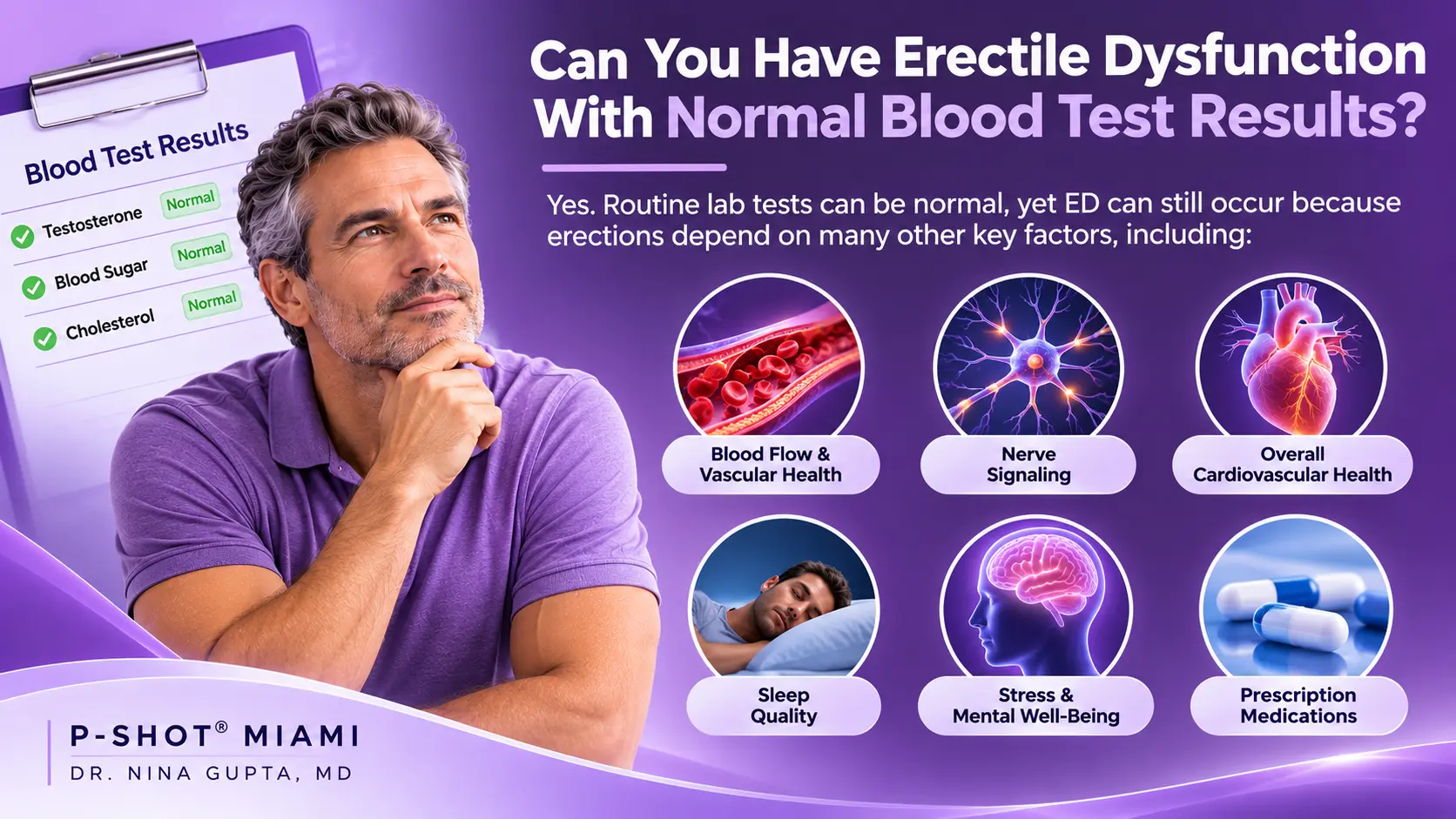
You have recently had your blood work done, and everything looks completely normal. Your total testosterone levels are comfortably within the expected reference range, your fasting blood sugar is healthy, and your cholesterol numbers are not raising any clinical red flags. Yet, you are still experiencing frustrating difficulty achieving or maintaining a firm erection.
So, what could be causing the problem?
Yes, you can absolutely have erectile dysfunction (ED) even when your routine blood test results are completely normal. Erectile function depends on vastly more than circulating hormone levels and standard laboratory measurements. Arterial circulation, microvascular endothelial reactivity, autonomic nerve signaling, cardiovascular health, prescription medications, sleep architecture, and psychological well-being all play vital, interconnected roles.
Understanding these non-laboratory factors is essential when searching for the true root cause of persistent erectile difficulties. At P-Shot® Miami, Dr. Nina Gupta, MD, emphasizes thorough, individualized, physician-performed evaluations to help men look beyond generic lab panels, understand their symptoms, and explore medically sound care options.
Normal routine blood work indicates systemic chemical balance, but it does not measure dynamic blood flow into the penis, microvascular endothelial relaxation, pelvic nerve transmission, or psychological stress. Normal labs do not rule out organic erectile dysfunction.
Understanding Erectile Dysfunction Despite Normal Blood Tests
Standard blood tests provide valuable information about your general health, organ function, and baseline endocrine balance. However, they cannot measure or replicate every physical process involved in achieving and sustaining an erection.
An erection is a complex neurovascular event that requires seamless, millisecond-by-millisecond coordination between your brain, spinal cord, parasympathetic nerves, vascular endothelium, arterial blood vessels, and specialized corporal smooth muscle tissue:
Neurological Signal
Sensory or psychological stimulation triggers parasympathetic nerve firing and local nitric oxide release.
Arterial Inflow
Helicine arteries dilate rapidly, surging arterial blood into the cavernosal spaces under high pressure.
Venous Occlusion
Expanding erectile tissue compresses emissary veins against the tunica albuginea, trapping blood to sustain firmness.
When one or more of these dynamic physiological systems falters, erectile difficulties develop. For example, your testosterone concentration may be in the upper normal range while arterial blood flow through the pudendal arteries remains restricted. Similarly, routine blood work cannot directly detect performance anxiety, subtle peripheral nerve entrapment, or medication-induced changes in neurotransmitter balance.
Why Normal Laboratory Results Do Not Tell the Whole Story
Routine blood tests typically evaluate static chemical markers in circulating venous blood—such as fasting glucose, lipid fractions, creatinine, liver enzymes, and total hormone concentrations. However, they do not directly evaluate:
- Penile microvascular blood circulation and dynamic peak systolic arterial velocity.
- Endothelial nitric oxide bioavailability and local cavernosal smooth muscle responsiveness.
- Cavernosal veno-occlusive competence (whether blood leaks out prematurely through incompetent valves).
- Autonomic nerve transmission between the sacral plexus and erectile tissue.
- Psychological stress pathways that stimulate vasoconstricting adrenaline and norepinephrine.
This fundamental discrepancy explains why many men continue to experience severe, persistent ED despite receiving reassuring "everything is normal" laboratory reports from their annual checkup. A comprehensive, physician-performed assessment is necessary to explore what is happening beneath the surface.
1. Poor Blood Circulation Despite Normal Cholesterol
Healthy arterial blood circulation is the fundamental physical prerequisite for achieving and maintaining an erection. During sexual stimulation, cavernosal smooth muscle relaxes, allowing arterial blood to rush into the spongy corporal bodies. If these delicate vessels cannot dilate properly, erections remain soft, inconsistent, or fade prematurely.
Interestingly, normal cholesterol levels do not guarantee healthy blood vessels. While severe hyperlipidemia is a known contributor to atherosclerosis, vascular impairment frequently develops long before circulating lipid numbers look alarming. Factors such as cigarette smoking, chronic high blood pressure, physical inactivity, natural vascular aging, and microvascular endothelial dysfunction can severely compromise erectile hemodynamics.
Endothelial dysfunction refers to functional damage to the ultra-thin inner cellular lining of blood vessels. When the endothelium is damaged, it loses its ability to synthesize and release adequate amounts of nitric oxide—the chemical messenger responsible for triggering vascular relaxation. As a result, your cholesterol report may look pristine, yet your penile arteries remain constricted and stiff.
2. Can Erectile Dysfunction Be an Early Warning Sign of Heart Disease?
In many men, erectile dysfunction serves as the earliest clinical warning sign of underlying cardiovascular disease. This connection is explained by the biological principle known as the Artery Size Hypothesis:
The penile arteries are miniature—measuring only 1 to 2 millimeters in diameter—compared to the coronary arteries supplying the heart (3 to 4 mm) and the carotid arteries supplying the brain (5 to 7 mm). Because of their tiny caliber, identical amounts of endothelial inflammation, arterial plaque, or microvascular stiffness will restrict blood flow in penile vessels two to five years before causing chest pain or heart symptoms.
This does not mean that every man who experiences erectile difficulty has impending heart disease. However, new or progressive erectile difficulties should never be dismissed, particularly when accompanied by abdominal adiposity, a history of smoking, elevated blood pressure, prediabetes, or a family history of premature heart disease.
Discussing cardiovascular risk factors during an in-person medical evaluation is an indispensable part of thoroughly investigating unexplained ED.
3. Normal Testosterone but Still Experiencing ED
When men notice erection difficulties, the most common assumption is that their testosterone must be low. Yet countless men undergo blood work only to find that their total testosterone sits squarely in the normal range (e.g., 500 to 700 ng/dL).
While testosterone is essential for male sexual wellness, it is not the physical mechanism that creates an erection:
- Testosterone regulates libido: It governs sexual interest, mental drive, nocturnal erections, mood, and baseline nitric oxide synthase enzymes.
- Blood vessels and nerves produce the erection: The actual mechanical stiffness required for penetrative intimacy is delivered by rapid arterial inflow, smooth muscle relaxation, and venous entrapment.
Furthermore, standard routine labs often check only total testosterone. In some men, elevated Sex Hormone-Binding Globulin (SHBG) binds tightly to circulating testosterone, leaving insufficient free (bioavailable) testosterone available to stimulate tissues. Elevated prolactin, abnormal thyroid-stimulating hormone (TSH), or elevated estradiol can also disrupt sexual performance despite an apparently "normal" total testosterone number.
Importantly, starting prescription Testosterone Replacement Therapy (TRT) simply because you experience ED is not medically appropriate when your hormones are already normal. Therapy must be guided by diagnostic symptoms and clinical findings.
4. Nerve Problems and Erectile Dysfunction
Erections require uninterrupted communication along the neurovascular axis—from cerebral erotic perception down through the spinal cord, sacral parasympathetic plexus, and cavernous nerves branching directly into penile tissue.
When neurological signaling is blunted or disrupted, erectile difficulties can develop rapidly, even while every routine blood test looks immaculate. Common neurological contributors include:
Prostatectomy, bladder surgery, or colorectal resection can traumatize the microscopic cavernous nerves running alongside the prostate.
Herniated lumbar discs, spinal stenosis, or spinal trauma can compress nerve roots responsible for sacral erectile reflex arcs.
Prolonged cycling on narrow bicycle saddles or chronic pelvic floor spasm can compress the pudendal nerve canal.
Peripheral autonomic neuropathy linked to subclinical metabolic disease, chronic alcohol exposure, or B-vitamin deficiencies.
A physician-performed clinical neurological and structural history can help identify whether subtle nerve issues are contributing to your symptoms.
5. Stress, Anxiety, and Performance Pressure
Your brain is the body's most powerful sex organ. Psychological well-being and autonomic balance directly dictate whether an erection can physically occur.
When you experience psychological stress, workplace pressure, relationship conflict, or performance anxiety, your body activates the sympathetic nervous system ("fight-or-flight"). Sympathetic stimulation floods your bloodstream with adrenaline (epinephrine) and norepinephrine. These stress hormones cause immediate, intense constriction of the smooth muscle in the penile arteries, physically preventing blood from pooling in the erectile chambers.
A classic presentation seen in clinical practice is the man who wakes up with firm morning erections (which occur during involuntary REM sleep when sympathetic tone is quieted) but experiences loss of firmness the moment intimacy begins. While this pattern strongly points toward a psychogenic component, psychological and physical factors frequently coexist. Performance anxiety often develops as a secondary reaction after a single episode of physical or fatigue-induced erectile softening, trapping men in an escalating cycle of fear and anticipation.
6. Medications That May Cause Erectile Dysfunction
A wide variety of common prescription and over-the-counter medications can directly interfere with erectile physiology without altering standard blood test markers.
If your erectile difficulties began shortly after starting a new prescription, increasing your dosage, or combining medications, discuss this timeline with your physician:
Common Medication Classes Linked to Erectile Difficulties:
- Blood Pressure Medications: Beta-blockers (such as metoprolol, atenolol) and thiazide diuretics can reduce penile arterial perfusion pressure.
- Antidepressants & Anxiolytics: Selective Serotonin Reuptake Inhibitors (SSRIs like sertraline, escitalopram) and SNRIs often blunt erectile quality, sensitivity, and orgasmic timing.
- 5-Alpha Reductase Inhibitors: Medications used for hair loss or benign prostatic hyperplasia (finasteride, dutasteride) reduce active dihydrotestosterone (DHT) signaling.
- Gastrointestinal & Allergy Drugs: H2-blockers, proton pump inhibitors, and sedating antihistamines can occasionally influence vascular tone or prolactin levels.
- Opioid Analgesics: Chronic opioid pain medications suppress hypothalamic-pituitary-gonadal pulsatility.
Important: Never abruptly discontinue or adjust prescription medications without direct medical guidance from your prescribing doctor. Often, a physician can suggest alternative medications that manage your underlying health condition without impairing sexual function.
7. Poor Sleep and Sleep Apnea
Sleep architecture is deeply intertwined with cardiovascular integrity, endothelial healing, hormone pulse secretion, and erectile vitality.
During normal deep rapid-eye-movement (REM) sleep, healthy adult men experience three to five spontaneous nocturnal erections (nocturnal penile tumescence, or NPT). These nocturnal erections are nature's way of re-oxygenating penile erectile tissue, supplying fresh arterial blood to corporal smooth muscle for hours each night.
Chronic sleep deprivation or untreated Obstructive Sleep Apnea (OSA) severely disrupts this restorative process. Sleep apnea causes repetitive airway collapses during sleep, leading to frequent oxygen desaturations (hypoxia), surges in systemic blood pressure, elevated oxidative stress, and chronic endothelial damage.
If you experience these warning signs alongside erectile difficulties, a sleep study evaluation can identify whether airway obstruction is stealthily degrading your vascular and sexual health.
8. Metabolic Health Beyond Blood Sugar
A "normal" fasting blood glucose result (for example, 92 mg/dL) provides only a snapshot of your metabolic state. It does not prove that your metabolic health is functioning optimally.
Many men experience early insulin resistance for years before fasting blood sugar creeps into the diabetic range. In the early stages of metabolic dysfunction, the pancreas overproduces insulin to compensate, keeping fasting glucose artificially normal while circulating insulin levels remain chronically elevated (hyperinsulinemia).
Chronic hyperinsulinemia directly harms the vascular system: it impairs endothelial nitric oxide production, promotes microvascular arterial stiffness, triggers visceral fat accumulation around abdominal organs, and stimulates systemic inflammation. Because penile microvessels are uniquely vulnerable, erectile decline often appears as the first clinical sign of insulin resistance.
A thorough medical assessment may explore Hemoglobin A1c (HbA1c), fasting insulin, visceral adiposity measurements, and advanced cardiovascular risk panels to assess metabolic health beyond simple fingerstick glucose.
What Tests Can Identify the Cause of Erectile Dysfunction?
Accurately identifying why erectile difficulties are occurring requires far more than repeating standard routine blood work over and over. A responsible medical assessment considers the whole patient.
Depending on your individual symptoms and medical history, comprehensive clinical evaluation may include:
Cardiovascular & Physical Exam
Blood pressure measurement, peripheral pulse palpation, body composition analysis, waist-to-hip ratio, and baseline cardiovascular risk factor scoring.
Expanded Endocrine Screening
When clinically indicated: morning Free and Total Testosterone, SHBG, Prolactin, Thyroid-Stimulating Hormone (TSH), and estradiol panels.
Medication & Psychosocial Review
Detailed medication reconciliation, alcohol/nicotine history, IIEF-5 sexual health index questionnaire, and evaluation of anxiety or relationship dynamics.
Penile Doppler Ultrasound
Specialized dynamic imaging that measures peak systolic velocity (arterial inflow) and end-diastolic velocity (venous entrapment) within the cavernosal arteries.
Penile Doppler ultrasound is especially informative when vascular problems or venous leak are suspected. Although not required for every man, it offers definitive, real-time visualization of cavernosal blood flow, answering questions that no blood test can address.
Treatment Options for Erectile Dysfunction With Normal Blood Tests
Because erectile dysfunction can stem from diverse physical, neurological, and emotional factors, effective treatment must be tailored to the specific underlying mechanism rather than relying on one-size-fits-all solutions.
Lifestyle Changes and Medical Treatments
Evidence-based lifestyle interventions can significantly enhance vascular endothelial function, reduce inflammation, and support natural erectile responsiveness:
- Aerobic Exercise: Regular moderate-to-vigorous cardiovascular activity (such as brisk walking, jogging, or cycling) stimulates endothelial nitric oxide production and improves pelvic arterial inflow.
- Smoking Cessation: Quitting smoking or nicotine vaping eliminates acute chemical vasoconstriction and promotes endothelial repair.
- Cardiovascular Nutrition: A Mediterranean-style dietary pattern rich in leafy greens, dietary nitrates, omega-3 fatty acids, and antioxidants supports vascular flexibility.
- Sleep & Stress Management: Treating sleep apnea with CPAP therapy and utilizing cognitive behavioral therapy (CBT) or sex therapy can break the cycle of performance anxiety.
When medical therapy is appropriate, established first-line options include:
FDA-approved medications such as sildenafil (Viagra) and tadalafil (Cialis) inhibit the enzyme PDE5, prolonging cyclic GMP to enhance blood flow during sexual arousal. Note: PDE5 inhibitors must never be taken with nitrate medications due to severe hypotensive risks.
Vacuum erection devices (VED), intraurethral alprostadil suppository, or prescription intracavernosal injection therapies (such as Trimix) can deliver targeted mechanical or pharmacological erections for men who do not respond to oral medications.
PRP Therapy and Other Emerging Treatments
Many men interested in non-pharmaceutical options inquire about regenerative medicine modalities, including Platelet-Rich Plasma (PRP), commonly known as the P-Shot® (Priapus Shot®), and low-intensity Acoustic Shockwave Therapy.
These therapies are investigated for their theoretical biological potential to stimulate localized cellular healing, promote angiogenesis (new microvessel development), and support endothelial health using autologous growth factors or acoustic energy.
However, scientific integrity requires transparent communication: the American Urological Association (AUA) classifies penile PRP injections as experimental, and the 2026 Sexual Medicine Society of North America (SMSNA) position statement recommends against routine clinical PRP use outside institutional review board (IRB)–approved clinical trials until convincing clinically meaningful efficacy is proven. Patients should discuss research limitations, safety, realistic goals, and established medical alternatives with a qualified physician before considering these procedures.
When Should You See a Doctor for Erectile Dysfunction?
Do not brush off persistent or recurring erectile difficulties simply because your recent blood test came back normal.
You should schedule a comprehensive medical evaluation if you notice:
- Erectile difficulties that persist for more than two to three months.
- A noticeable loss of erection firmness, rigidity, or the inability to sustain an erection until completion.
- A sudden or progressive disappearance of spontaneous nocturnal and morning erections.
- Symptoms that cause relationship strain, emotional distress, or loss of sexual confidence.
- Erectile changes occurring alongside chest tightness, shortness of breath upon exertion, or leg cramping.
An early evaluation not only helps identify effective, personalized solutions for your intimate vitality—it also serves as a vital safeguard for your overall cardiovascular and metabolic health.
Frequently Asked Questions About ED and Normal Blood Tests
Personalized Erectile Dysfunction Evaluation in Miami
Erectile dysfunction is not solely caused by low testosterone, elevated blood sugar, or abnormal cholesterol. As clinical evidence demonstrates, it involves multiple interconnected bodily systems—including cardiovascular circulation, microvascular endothelial integrity, autonomic nerve function, endocrine balance, medications, sleep quality, and emotional well-being.
At P-Shot® Miami, Dr. Nina Gupta, MD, ABAARM, FAARM, brings more than 37 years of clinical medical experience to individualized men's sexual health assessments.
Dr. Gupta is board certified by the American Board of Anti-Aging and Regenerative Medicine (ABAARM), an active member of the American Academy of Anti-Aging Medicine (A4M), and has maintained continuous directory membership in the Cellular Medicine Association Priapus Shot® provider directory since January 2017. All consultations and procedures are administered personally by Dr. Gupta in an exclusive, discreet clinical environment.
Our Miami clinic is conveniently located at 20200 W Dixie Hwy 808a, Miami, FL 33180, welcoming patients from Sunny Isles Beach, Bal Harbour, North Miami, Pembroke Pines, Fort Lauderdale, and surrounding South Florida communities.
Normal blood tests do not mean your erectile difficulties should be ignored. Take the next proactive step toward understanding your sexual health. Call or text 305-521-8522 or schedule your confidential consultation online today.
This article is intended strictly for educational and informational purposes and does not replace individualized medical advice, clinical diagnosis, or treatment recommendations. Treatment suitability and outcomes vary based on individual health history. Platelet-rich plasma (PRP) and low-intensity shockwave therapy for erectile dysfunction remain investigational. Always consult a qualified physician regarding established treatments, potential risks, and available clinical evidence.
- American Urological Association (AUA). Erectile Dysfunction: AUA Guideline (2018, Amended 2024). Details cardiovascular evaluation, vascular risk factors, and classifies restorative therapies as experimental. AUA Guidelines.
- Sexual Medicine Society of North America (SMSNA). Position Statement on Restorative Therapies for Erectile Dysfunction (2026). Highlights clinical trial requirements for PRP and shockwave therapies. SMSNA Statements.
- Montorsi P, Ravagnani PM, Galli S, et al. Association between erectile dysfunction and coronary artery disease. Role of the "artery size hypothesis". Am J Cardiol. Seminal study establishing penile microvascular dysfunction as a sentinel marker for systemic atherosclerosis.
- European Association of Urology (EAU). Guidelines on Sexual and Reproductive Health. Management of Erectile Dysfunction, Diagnostic Doppler Ultrasound, and Investigational Therapies. EAU Guidelines.
- National Institute of Diabetes and Digestive and Kidney Diseases (NIDDK). Erectile Dysfunction: Symptoms, Causes, and Diagnosis. NIDDK ED Resources.