Understanding Peyronie’s Disease
Peyronie’s disease is one of the most misunderstood and under-discussed conditions affecting men’s sexual health. Despite its prevalence, many men delay seeking treatment because of embarrassment, uncertainty, or the mistaken belief that nothing can be done. The condition occurs when fibrous scar tissue, commonly known as plaque, develops inside the penis. As this scar tissue accumulates, it can interfere with the normal expansion of penile tissue during an erection, leading to curvature, shortening, narrowing, pain, and in some cases significant erectile dysfunction.
The impact of Peyronie’s disease often extends far beyond physical symptoms. Men frequently report a decline in self-confidence, increased performance anxiety, and strain within intimate relationships. For some, the emotional consequences can be as challenging as the physical changes. Sexual health is closely tied to overall well-being, and when Peyronie’s disease affects intimacy, confidence, and body image, the effects can ripple through many areas of life.
Over the last decade, treatment options have evolved considerably. Traditional approaches focused primarily on symptom management or surgical correction of severe deformities. Today, regenerative medicine is changing the conversation. Therapies such as the P-Shot (Priapus Shot) and Low-Intensity Shockwave Therapy (LiSWT) are attracting attention because they aim to support tissue healing, improve blood flow, and potentially enhance penile function without surgery. Many specialists are now exploring whether combining these two treatments may offer advantages that exceed what either therapy can accomplish alone.
What Is Peyronie’s Disease?
Peyronie’s disease develops when scar tissue forms beneath the skin of the penis. The exact cause varies from person to person, but repetitive microtrauma during sexual activity is believed to be a common trigger. In some men, even minor injuries may initiate an abnormal healing response that results in excessive collagen deposition and plaque formation. Genetic predisposition, connective tissue disorders, diabetes, and age-related changes may also increase risk.
The condition typically progresses through two phases. The first is known as the active or acute phase, during which scar tissue develops and changes continue to occur. Men may experience penile pain, increasing curvature, and noticeable alterations in erection quality during this stage. The second phase is the stable phase, where the deformity generally stops worsening but remains present.
One of the reasons Peyronie’s disease can be so frustrating is that symptoms vary dramatically. Some men develop only mild curvature, while others experience severe deformities that interfere with intercourse. This variability means treatment plans must be tailored to individual needs rather than relying on a one-size-fits-all approach. Regenerative therapies have gained popularity because they offer a more personalized strategy aimed at improving overall tissue health.
How Peyronie’s Disease Affects Sexual Health and Confidence
The physical effects of Peyronie’s disease are often obvious, but the psychological burden is frequently underestimated. Men may become increasingly self-conscious about changes in penile appearance, leading them to avoid intimacy altogether. Even when erections remain functional, anxiety surrounding sexual performance can create additional difficulties.
Research has shown that a significant percentage of men with Peyronie’s disease experience symptoms of depression, relationship stress, or reduced quality of life. The condition often affects both partners, creating communication challenges and emotional strain. It is not uncommon for patients to describe feeling isolated, particularly because many men are reluctant to discuss sexual health concerns openly.
This emotional dimension helps explain why newer treatment approaches focus on more than just reducing curvature. Therapies such as the P-Shot and Shockwave Therapy aim to support overall penile health, erectile function, and tissue quality. By addressing multiple aspects of sexual wellness simultaneously, these treatments may help improve both physical outcomes and confidence levels.
Traditional Treatments for Peyronie’s Disease
Before exploring the potential benefits of combining the P-Shot and Shockwave Therapy, it is important to understand the limitations of traditional treatment approaches. For many years, treatment options were relatively limited, particularly for men seeking alternatives to surgery.
Medications and Injectable Therapies
Oral medications have historically been prescribed in an attempt to reduce inflammation or slow scar tissue formation. Treatments such as vitamin E, pentoxifylline, and various antioxidant regimens have been studied extensively. While some patients report mild improvements, scientific evidence supporting dramatic benefits remains limited.
Injectable therapies have produced more encouraging results in selected patients. Collagenase injections, for example, are designed to break down Peyronie’s plaque and reduce curvature. These treatments can be effective for some men, but they often require multiple sessions and may involve bruising, swelling, discomfort, and significant expense.
A common criticism of many traditional therapies is that they focus primarily on the existing scar tissue. While reducing plaque is important, these approaches may not fully address underlying tissue health, blood flow, or regenerative capacity. This gap has fueled interest in treatments that support biological healing mechanisms rather than simply targeting symptoms.
Surgical Options and Their Limitations
Surgery remains the most definitive treatment for severe Peyronie’s disease. Procedures may involve plication techniques, plaque incision with grafting, or penile implants when erectile dysfunction is significant. In appropriate candidates, surgery can provide substantial curvature correction and improved function.
However, surgery is rarely considered a first-line treatment because it carries inherent risks. Potential complications include penile shortening, sensory changes, infection, erectile dysfunction, and recovery periods that may require weeks or months. Many men understandably prefer to exhaust conservative and regenerative options before considering an operation.
This desire for less invasive alternatives has contributed to the growing popularity of therapies such as PRP and Shockwave Therapy. These treatments seek to support natural biological processes while minimizing downtime and procedural risks.
What Is the P-Shot?
The P-Shot, or Priapus Shot, is a regenerative procedure that uses Platelet-Rich Plasma (PRP) derived from the patient’s own blood. PRP contains concentrated platelets rich in growth factors that play a critical role in tissue repair, blood vessel formation, and cellular regeneration.
The procedure begins with a simple blood draw. The blood is processed in a centrifuge to separate and concentrate the platelets. The resulting PRP is then strategically injected into penile tissue. Because the treatment uses the patient’s own biological material, the risk of allergic reactions or rejection is extremely low.
The popularity of the P-Shot has expanded rapidly in men’s sexual health because it targets tissue quality rather than merely masking symptoms. Patients often seek treatment for erectile dysfunction, sexual performance concerns, and Peyronie’s disease. While outcomes vary, many men report improvements in erection quality, sensitivity, circulation, and overall sexual confidence.
The Role of Platelet-Rich Plasma (PRP)
PRP is often described as a concentrated source of the body’s natural healing components. Platelets contain growth factors such as vascular endothelial growth factor (VEGF), platelet-derived growth factor (PDGF), and transforming growth factor-beta (TGF-β), which help coordinate tissue repair.
In Peyronie’s disease, where abnormal healing contributes to scar tissue formation, PRP may help create a healthier biological environment. The goal is not simply to remove plaque but to encourage improved tissue function and regenerative activity. This distinction is important because healthy tissue remodeling may influence long-term outcomes more effectively than symptom-focused treatments alone.
The regenerative philosophy behind PRP mirrors developments occurring across many medical specialties, including orthopedics, sports medicine, and wound care. Physicians increasingly recognize the value of therapies that work with the body’s natural healing mechanisms rather than relying exclusively on surgical intervention.
How the P-Shot Supports Tissue Regeneration
The potential value of the P-Shot lies in its ability to support multiple aspects of penile health simultaneously. Improved blood flow, enhanced tissue oxygenation, and increased regenerative activity may contribute to better erectile function and overall tissue quality.
Many men with Peyronie’s disease also struggle with erectile dysfunction. This overlap is significant because vascular health plays a central role in both conditions. By potentially improving circulation and supporting tissue repair, PRP may address issues that extend beyond curvature alone.
Rather than focusing on a single symptom, the P-Shot aims to optimize the biological environment within penile tissue. This broader therapeutic objective is one of the reasons it has become an increasingly popular component of modern Peyronie’s disease treatment strategies.
What Is Shockwave Therapy?
Shockwave Therapy, often referred to as Low-Intensity Extracorporeal Shockwave Therapy (Li-ESWT) or simply Shockwave Therapy, has become one of the most talked-about innovations in men’s sexual health. Originally developed and studied in fields such as orthopedics and sports medicine, the technology has gradually found its way into urology and sexual medicine because of its potential to improve blood flow, stimulate tissue repair, and support regenerative processes.
Unlike surgical procedures or medications that temporarily address symptoms, Shockwave Therapy aims to trigger biological responses within the treated tissue. The treatment uses low-intensity acoustic waves delivered through a specialized handheld device. These acoustic waves create controlled mechanical stimulation that encourages the body to activate healing pathways. In penile tissue, this may lead to improved circulation, enhanced cellular activity, and increased formation of new blood vessels, a process known as angiogenesis.
For men with Peyronie’s disease, this approach is particularly interesting because the condition involves more than just scar tissue. Many patients also experience impaired blood flow, reduced erectile quality, tissue rigidity, and discomfort during erections. By targeting the health of the underlying tissue, Shockwave Therapy may provide benefits that extend beyond simply addressing penile curvature.
The treatment itself is typically performed in an outpatient setting and requires little to no downtime. Sessions are usually completed within a relatively short period, allowing patients to return to their daily routines immediately afterward. Because it is non-invasive, many men find Shockwave Therapy appealing as an early intervention option before considering more aggressive treatments.
Understanding Low-Intensity Shockwave Technology
To understand why Shockwave Therapy has gained attention in Peyronie’s disease treatment, it helps to look at how the technology works on a biological level. The acoustic waves generated during treatment create microscopic mechanical stress within tissues. While the word "stress" may sound concerning, this controlled stimulation is actually what prompts the body to activate healing responses.
Think of it as a wake-up call for dormant repair mechanisms. When tissues receive these low-intensity shockwaves, the body responds by increasing blood flow, recruiting regenerative cells, and releasing growth factors associated with healing and tissue remodeling. These effects have been observed in various areas of medicine, including the treatment of tendon injuries, chronic pain conditions, and vascular disorders.
In the context of Peyronie’s disease, researchers are particularly interested in how Shockwave Therapy may influence inflammation, tissue flexibility, and penile blood flow. Since poor vascular function often accompanies Peyronie’s disease, improving circulation could potentially enhance erectile function while supporting healthier tissue behavior. Although Shockwave Therapy is not generally viewed as a standalone cure for Peyronie’s disease, its ability to improve the tissue environment makes it a compelling component of a broader treatment strategy.
The growing body of research on Shockwave Therapy has also fueled interest in combining it with regenerative procedures such as the P-Shot. Since both treatments target tissue health through different mechanisms, many specialists believe they may complement one another in meaningful ways.
Benefits of Shockwave Therapy for Penile Health
One reason Shockwave Therapy has become increasingly popular is its broad range of potential benefits. Unlike treatments that focus exclusively on one symptom, Shockwave Therapy addresses several biological factors that contribute to sexual function.
Patients commonly seek Shockwave Therapy because it may help:
- Improve penile blood flow
- Enhance erectile quality
- Support new blood vessel formation
- Promote tissue repair and regeneration
- Reduce discomfort associated with certain penile conditions
- Complement other regenerative therapies
These potential benefits are particularly relevant for men with Peyronie’s disease because erectile dysfunction and vascular impairment frequently coexist with penile curvature. A treatment that addresses circulation while supporting tissue health may therefore provide advantages that go beyond structural correction alone.
Many physicians now view Shockwave Therapy as part of a comprehensive sexual wellness strategy rather than a standalone intervention. This philosophy has naturally led to increased interest in combining Shockwave Therapy with PRP-based procedures such as the P-Shot.
Why Combining P-Shot and Shockwave Therapy Makes Sense
The idea of combining therapies is not new in medicine. In many specialties, better outcomes are often achieved by targeting a condition from multiple angles rather than relying on a single treatment. The growing interest in combining the P-Shot with Shockwave Therapy stems from this same principle.
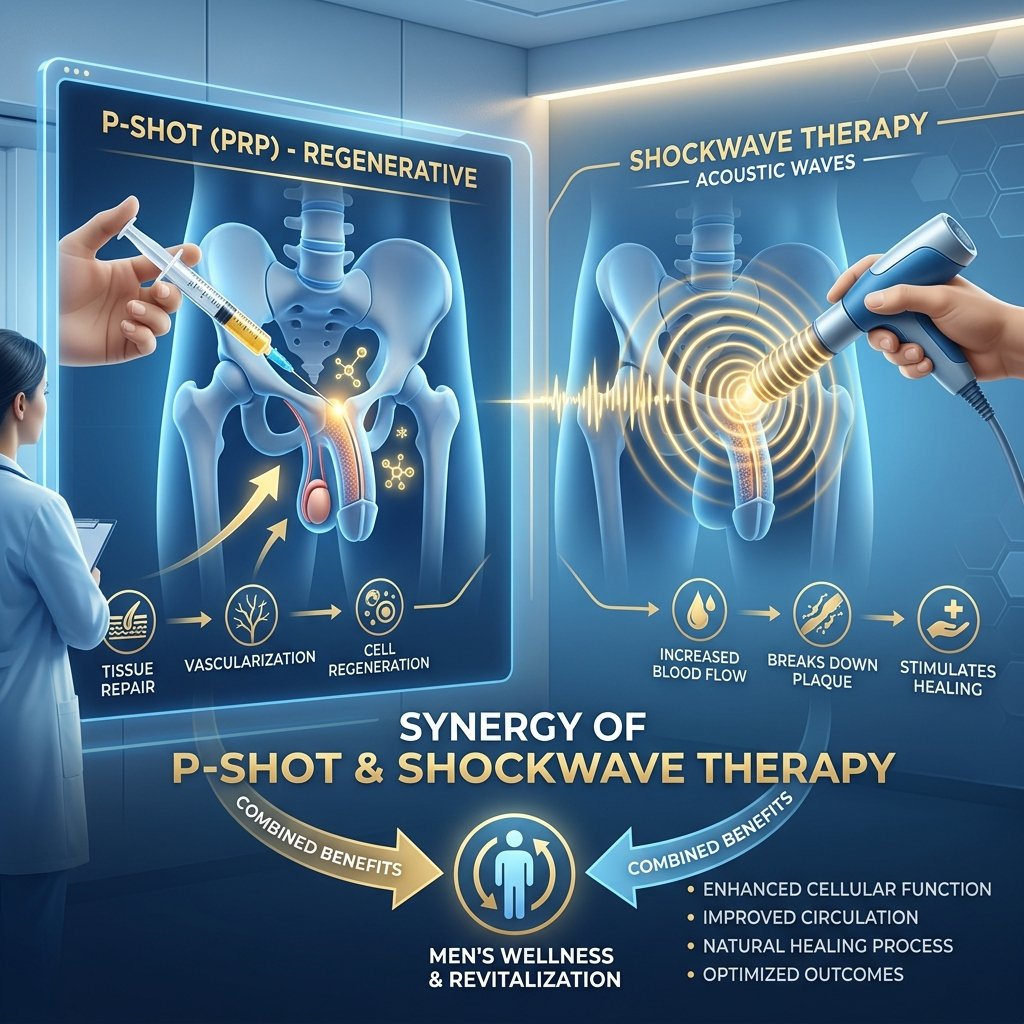
Both treatments are designed to support healing and regeneration, but they work through different biological pathways. The P-Shot delivers concentrated growth factors directly into penile tissue, while Shockwave Therapy stimulates the body’s own regenerative responses through acoustic energy. Together, these therapies may create a more favorable environment for tissue repair, vascular improvement, and functional recovery.
For Peyronie’s disease patients, this combined approach is especially appealing because the condition involves multiple overlapping issues. Scar tissue formation, inflammation, vascular dysfunction, erectile difficulties, and psychological stress can all contribute to the overall burden of the disease. Addressing only one of these factors may limit treatment success.
Combining regenerative therapies offers the possibility of a more comprehensive strategy. Rather than simply focusing on curvature measurements, clinicians can target overall penile health, tissue quality, and sexual function simultaneously.
Regeneration Meets Stimulation
One way to think about the combination is to view the P-Shot as supplying regenerative building materials while Shockwave Therapy activates the construction crew. PRP introduces concentrated growth factors that may support healing, while shockwaves stimulate cellular activity and blood vessel formation within the treated tissue.
This synergy has become one of the most compelling arguments for combining the treatments. The biological signals provided by PRP may become more effective when paired with the increased circulation and cellular responsiveness associated with Shockwave Therapy. Although more research is needed to fully understand the interaction, many practitioners believe the treatments complement each other naturally.
Patients often appreciate this dual approach because it addresses both tissue regeneration and vascular performance. Since healthy erections depend heavily on blood flow, any treatment strategy that supports circulation while encouraging tissue repair may provide broader benefits than either therapy alone.
The concept is similar to planting seeds in fertile soil and then ensuring they receive adequate water and sunlight. Each component supports the effectiveness of the other, creating conditions that may be more favorable for growth and recovery.
Potential Synergy in Peyronie’s Disease Treatment
The potential synergy between the P-Shot and Shockwave Therapy is one of the primary reasons the combination has gained popularity among regenerative medicine specialists. While neither treatment should be viewed as a guaranteed cure, together they may help address several important aspects of Peyronie’s disease.
Potential goals of combination therapy include:
| Treatment Goal | P-Shot Contribution | Shockwave Contribution |
|---|---|---|
| Tissue Regeneration | Growth factors and cellular signaling | Stimulates repair mechanisms |
| Blood Flow Improvement | Supports vascular health | Encourages angiogenesis |
| Erectile Function | Enhances tissue quality | Improves circulation |
| Recovery Environment | Promotes healing response | Activates regenerative pathways |
| Sexual Wellness | Supports overall penile health | Enhances vascular performance |
This complementary relationship is what makes the combination particularly attractive for men seeking non-surgical treatment options. Rather than relying on a single mechanism of action, the therapy addresses multiple biological processes involved in penile health.
Many clinicians report that patients are increasingly interested in treatments that focus on restoration rather than symptom suppression. The combination of PRP and Shockwave Therapy fits squarely within this regenerative medicine philosophy.
Improving Blood Flow and Tissue Remodeling
Healthy penile tissue depends on robust circulation. Without adequate blood flow, tissues receive less oxygen and fewer nutrients, potentially limiting their ability to heal and function properly. This reality helps explain why vascular health is such an important consideration in Peyronie’s disease management.
Shockwave Therapy has been extensively studied for its ability to stimulate new blood vessel formation and improve circulation. When combined with PRP, which contains growth factors associated with tissue repair, the result may be a more supportive environment for tissue remodeling.
Although plaque reduction remains a key objective in Peyronie’s disease treatment, many experts believe tissue quality and vascular performance are equally important. A penis that functions better, feels healthier, and supports stronger erections may significantly improve quality of life even when structural changes are modest.
This broader perspective is reshaping how many practitioners approach Peyronie’s disease. Rather than focusing solely on curvature, they increasingly emphasize overall penile health and long-term functional outcomes.
What Research and Clinical Experience Suggest
Scientific research on the combined use of the P-Shot and Shockwave Therapy is still evolving, but several trends have emerged. Early studies and clinical observations suggest that regenerative approaches may offer meaningful benefits for selected patients, particularly when used during earlier stages of Peyronie’s disease.
Healthcare providers who regularly use these therapies often report improvements in erectile function, penile blood flow, sexual confidence, and patient satisfaction. While curvature reduction varies among individuals, many patients value improvements in function and quality of life just as much as changes in physical appearance.
One of the strengths of regenerative medicine is that it focuses on biological optimization rather than simply masking symptoms. This distinction has contributed to growing patient interest and increasing clinical adoption.
Emerging Evidence
Research into PRP and Shockwave Therapy continues to expand. Studies examining Shockwave Therapy alone have demonstrated promising effects on vascular function and erectile performance. PRP research has highlighted its regenerative potential across numerous medical specialties.
The combination of these therapies is a logical extension of existing regenerative principles. Although large-scale studies specifically examining Peyronie’s disease are still needed, the biological rationale supporting combination treatment remains strong.
Patients should understand that regenerative medicine is a rapidly evolving field. As new evidence emerges, treatment protocols will likely become more refined and personalized.
Patient Outcomes and Real-World Observations
Real-world clinical experience often provides valuable insights alongside formal research. Many practitioners report that patients appreciate the minimally invasive nature of combination therapy and the fact that treatment can often be completed without disrupting normal activities.
Commonly reported benefits include improved erection quality, enhanced confidence, better sexual performance, and increased satisfaction with overall penile function. While results vary, the combination approach appears particularly appealing to men who wish to explore regenerative options before considering surgery.
Patients frequently describe feeling empowered by taking proactive steps toward improving their condition. This psychological benefit should not be underestimated, especially for a disease that often affects self-esteem and intimate relationships.
Who Is an Ideal Candidate?
One of the most common questions men ask after learning about regenerative treatments is whether they are good candidates for therapy. The answer depends on several factors, including the stage of Peyronie’s disease, the severity of symptoms, overall health, erectile function, and personal treatment goals. While no single therapy is right for every patient, many specialists believe that combining the P-Shot and Shockwave Therapy may be particularly beneficial for men who want to address the condition before it progresses to the point where surgery becomes necessary.
A key advantage of regenerative treatments is that they can often be incorporated into a personalized treatment plan. Unlike surgery, which typically involves a specific procedural pathway, regenerative medicine allows physicians to tailor therapy based on the unique characteristics of each patient. Some men may benefit from PRP and Shockwave Therapy alone, while others may achieve the best outcomes when these treatments are combined with traction therapy, lifestyle modifications, hormone optimization, or other interventions designed to support sexual health.
Another important consideration is patient mindset. Men who actively participate in their treatment process often achieve better long-term outcomes. Peyronie’s disease management is rarely about a single appointment or a single procedure. Instead, it often involves a broader commitment to tissue health, cardiovascular wellness, and ongoing monitoring. Patients who understand this are typically well-positioned to benefit from regenerative strategies.
The growing interest in non-surgical solutions reflects a broader shift in healthcare. Many people today prefer treatments that support the body's natural healing mechanisms whenever possible. This philosophy aligns closely with the goals of both PRP and Shockwave Therapy, making the combination especially attractive to men who value minimally invasive options.
Early-Stage Peyronie’s Disease
Many regenerative medicine specialists believe that the greatest opportunities for improvement may exist during the earlier phases of Peyronie’s disease. During the active stage, the tissue is still undergoing changes, inflammation may still be present, and scar formation is often evolving. This period potentially provides a window during which biological interventions can have a greater influence on tissue behavior.
The logic is straightforward. It is often easier to influence a process while it is actively developing than after it has become fully established. Once Peyronie’s plaque becomes mature and stable, structural changes may be more difficult to modify. This does not mean treatment is ineffective in later stages, but it helps explain why many physicians encourage early evaluation and intervention.
Men who have recently noticed penile curvature, pain during erections, changes in shape, loss of length, or declining erectile quality should consider seeking professional assessment rather than adopting a wait-and-see approach. Early treatment may not only address current symptoms but also potentially reduce the risk of further progression.
The combination of the P-Shot and Shockwave Therapy is particularly appealing during this stage because it targets both regeneration and vascular health. Rather than focusing solely on the visible deformity, treatment aims to improve the overall biological environment within penile tissue. This comprehensive strategy aligns well with modern regenerative medicine principles.
Men Seeking Non-Surgical Solutions
Not every man with Peyronie’s disease requires surgery, and many would prefer to avoid it altogether if possible. Concerns about recovery time, procedural risks, potential complications, and permanent anatomical changes often motivate patients to explore conservative alternatives first.
This is where the combination of PRP and Shockwave Therapy stands out. Both treatments are minimally invasive, generally well tolerated, and associated with little downtime. Patients can often continue working, exercising, and participating in normal activities while undergoing therapy. This convenience makes treatment more accessible and less disruptive to daily life.
The desire for non-surgical solutions is not simply about avoiding an operation. Many men are attracted to therapies that emphasize restoration rather than correction. Surgery can effectively address structural issues, but regenerative treatments seek to enhance tissue quality, improve blood flow, and support natural healing processes. For patients who value this philosophy, the combination of the P-Shot and Shockwave Therapy represents a logical first step.
Another factor driving interest is the overlap between Peyronie’s disease and erectile dysfunction. Since both conditions often involve vascular and tissue health concerns, treatments that support circulation and regeneration may provide broader benefits than therapies focused exclusively on curvature reduction.
Finding the Right Provider
The effectiveness of any treatment depends not only on the therapy itself but also on the expertise of the provider administering it. Peyronie’s disease is a complex condition that requires careful evaluation, individualized planning, and realistic expectation setting. Choosing an experienced provider is therefore one of the most important decisions a patient can make.
A qualified practitioner should perform a thorough assessment that includes a detailed medical history, evaluation of penile curvature, assessment of erectile function, and discussion of treatment goals. This process helps ensure that therapy is appropriately matched to the patient’s needs. Providers who specialize in men’s sexual health are often better equipped to recognize subtle factors that may influence treatment outcomes.
Patients should also look for clinics that emphasize education and transparency. Understanding what regenerative therapies can and cannot achieve is essential for making informed decisions. The best providers take the time to explain treatment options, discuss available evidence, and create realistic expectations.
For men interested in learning more about regenerative approaches to Peyronie’s disease, Dr. Nina Gupta at P-Shot Miami offers valuable experience and expertise in the P-Shot, Shockwave Therapy, and comprehensive sexual wellness programs designed specifically for male patients. Access to specialized expertise can make a significant difference in both treatment experience and overall satisfaction.
Importance of Experience and Personalized Treatment
Peyronie’s disease affects every patient differently. Two men may have similar degrees of curvature yet completely different concerns, goals, and treatment priorities. One patient may be focused primarily on erectile function, while another may be more concerned about penile appearance or discomfort during intercourse.
This variability highlights the importance of personalized treatment planning. Experienced providers understand that successful outcomes are not measured solely by curvature angles or imaging studies. Quality of life, confidence, relationship satisfaction, and sexual performance are equally important considerations.
Regenerative medicine is particularly well suited to individualized care because treatment protocols can often be adapted based on patient characteristics. The number of sessions, combination therapies, follow-up schedules, and complementary interventions can all be adjusted to optimize results.
Patients should feel comfortable asking questions about provider experience, treatment philosophy, expected outcomes, and available alternatives. Open communication creates a stronger partnership between patient and clinician, ultimately supporting better decision-making and greater satisfaction with care.
Conclusion
Peyronie’s disease remains one of the most challenging conditions in men’s sexual health, affecting not only penile structure but also confidence, intimacy, and overall quality of life. Traditional treatments such as medications, injections, and surgery continue to play important roles, but they do not always address the broader biological factors involved in the condition.
The combination of the P-Shot and Shockwave Therapy represents an exciting development in regenerative medicine. By pairing the growth factor-rich regenerative potential of Platelet-Rich Plasma (PRP) with the circulation-enhancing and tissue-stimulating effects of Low-Intensity Shockwave Therapy, clinicians may be able to create a more supportive environment for healing, vascular improvement, and tissue remodeling.
While research continues to evolve, the biological rationale behind this combination is compelling. The therapies complement one another by targeting different aspects of tissue health, making them an attractive option for men seeking non-surgical treatment approaches. Many patients are drawn to the possibility of improving erectile function, enhancing blood flow, supporting tissue quality, and addressing Peyronie’s disease through regenerative rather than corrective methods.
As with any medical treatment, individual results vary and consultation with an experienced provider is essential. For many men, however, the combination of P-Shot and Shockwave Therapy may represent one of the most promising early-intervention strategies currently available in the field of sexual medicine.
What We See in Our Practice
At P-Shot Miami, we routinely see the synergistic effects of combining PRP therapy with Shockwave Therapy. Patients dealing with curvature and erectile difficulties often notice faster improvements in vascular response and tissue softening when these two therapies are paired. While no treatment is a guaranteed cure, this combination often proves to be a powerful alternative for men wanting to avoid surgical interventions.
Medical References
- National Institutes of Health (NIH) - U.S. National Library of Medicine. Overview of Low-Intensity Extracorporeal Shockwave Therapy for men's sexual health.
- American Urological Association (AUA). Guidelines on the management of Peyronie's disease and non-surgical interventions.
- Sexual Medicine Society of North America (SMSNA). Clinical research on the synergy of Shockwave Therapy and Platelet-Rich Plasma.
- International Society for Sexual Medicine (ISSM). Patient information on vascular health, penile curvature, and regenerative therapies.